Jar
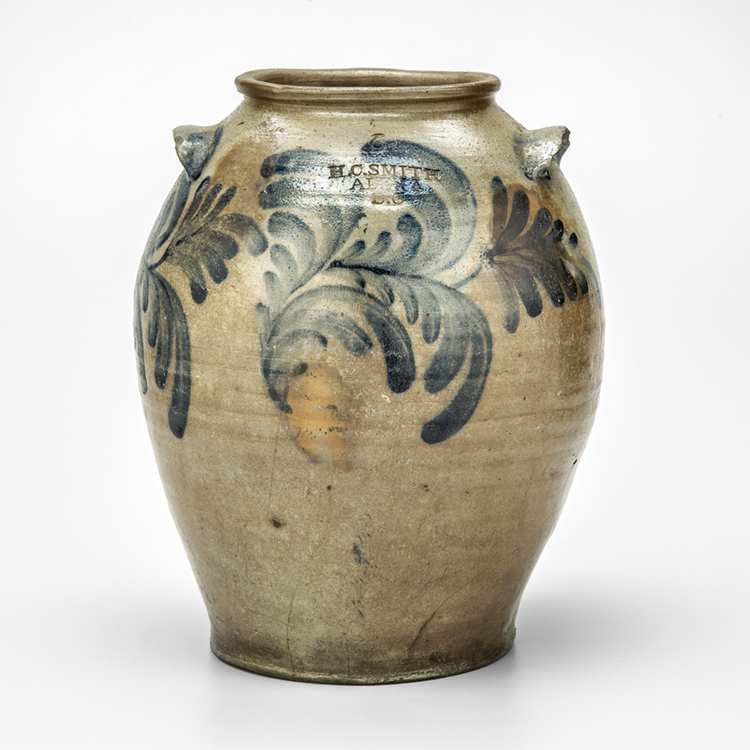
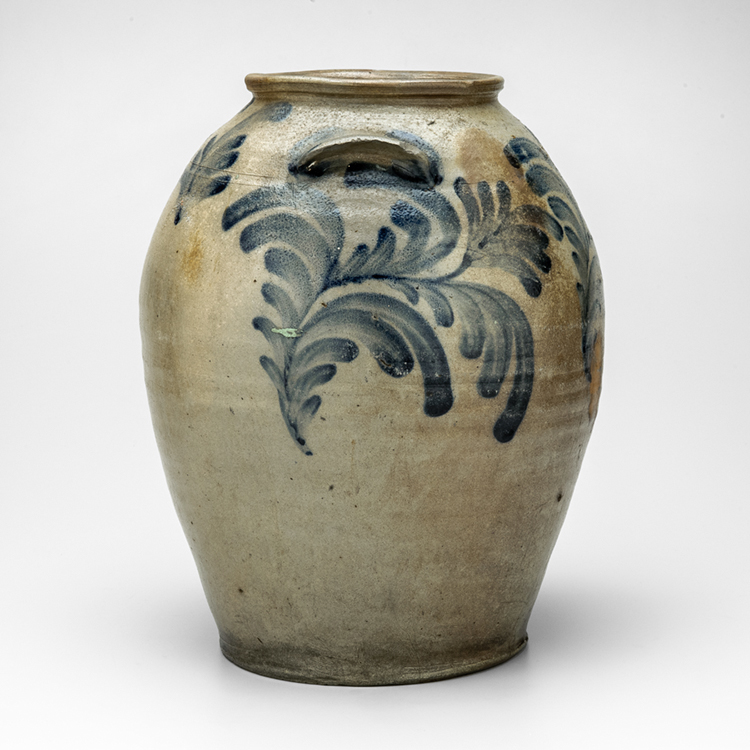
Salt glazing is a technique used by stoneware potters to create the glassy surface. When the pottery kiln reached over 2000 degrees Fahrenheit, salt was introduced to the kiln, creating a vapor. This vapor adhered to the silica in the clay, forming a glass. From the high temperature, the clay is often non-porous, or vitrified. This, combined with the salt glazing, allowed the potters to not have to apply a glaze to the interior of the vessel. It could hold liquids and not seep, unlike earthenware storage vessels.
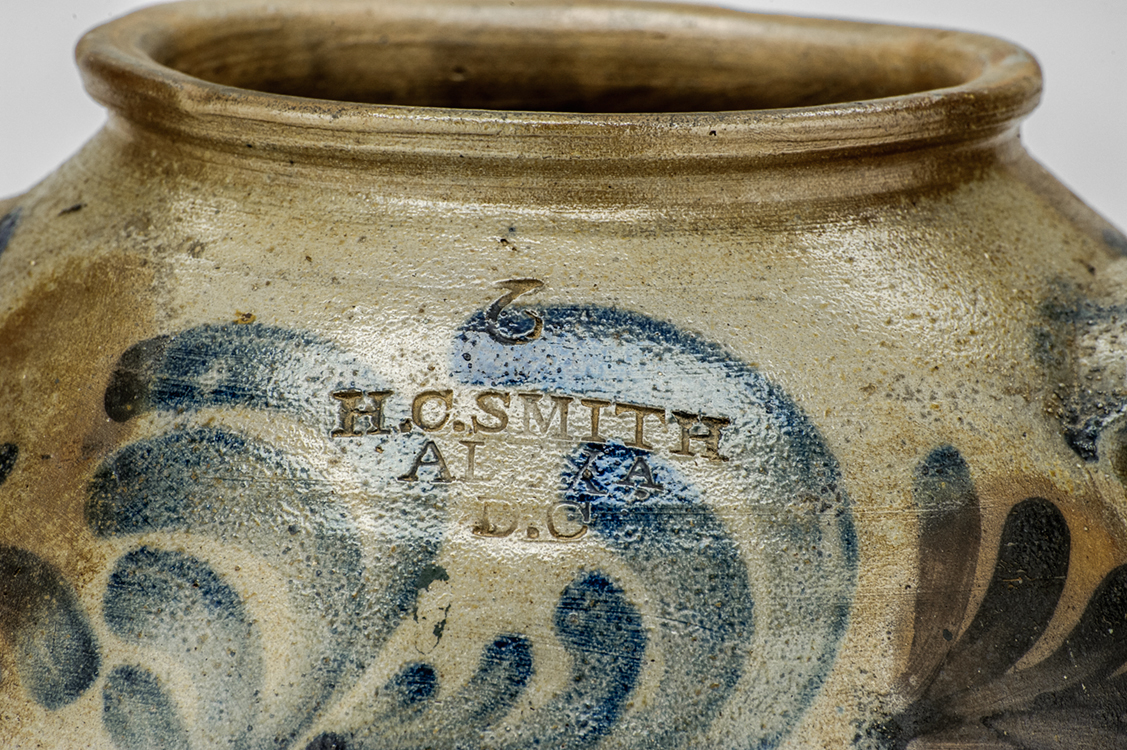
MAKER: Hugh Smith was not a potter, rather he and his son, Hugh Charles (H.C.) Smith, operated a china shop in Alexandria and owned a stoneware pottery. Hugh Smith, Sr. began managing the stoneware manufactory on Wilkes Street in 1825. In 1841 the business was sold to potter Benedict C. Milburn (1805-1867). Potters John Swann and Benedict C. Milburn had been employed by the Smiths at the Wilkes Street pottery as well as several African-American potters, such as David Jarbour.
The earliest known advertisements in the ALEXANDRIA GAZETTE for Hugh Smith, Sr. (1768-1852) appear in 1796 when he is referred to as an importer of fine china. By 1803, Smith was operating a retail establishment on King Street, convenient to the docks where shipments of ceramics were brought in. Hugh Smith entered into various partnerships prior to 1825 (often with family members such as his son J.P. Smith) but it was in 1825 that his son, Hugh Charles (H.C.) (1804-1850) joined the business. It was also in 1825 that Hugh Smith, Sr. left the retail end of the family business and began managing a stoneware pottery on Wilkes Street. Beginning in 1831, advertisements indicate that Hugh Charles managed the retail firm on his own for four years as the company name was changed from H. Smith & Company to H.C. Smith. In 1835 the name changed again to include “Company.” The Smith family’s management of the pottery manufacturing enterprise continued until 1841. Hugh Smith, Sr. remained the owner of the store on King Street until 1851 when his son James P. Smith took over. James P. Smith sold the firm in 1854.
Magid, Barbara. “‘Stone-ware of excellent quality, Alexandria manufacture,’” Ceramics in America, 2012.
Wilder, Eddie L. “Alexandria, Virginia Pottery 1792-1876” Marceline, MO: Wadsworth Publishing Company, 2007.
Myers, Suzita Cecil. “Hugh Smith and Hugh Charles Smith (1825-1841).” THE POTTER’S ART: SALT GLAZED STONEWARE OF NINETEENTH-CENTURY ALEXANDRIA (Alexandria 1983) 14-21.
Other related objects documented in the MESDA research files include: S-7762, S-7763, S-7761, S-7769, S- 7770, S-7749, S-7765, S-4139, S-7764, S-7771.