Jar
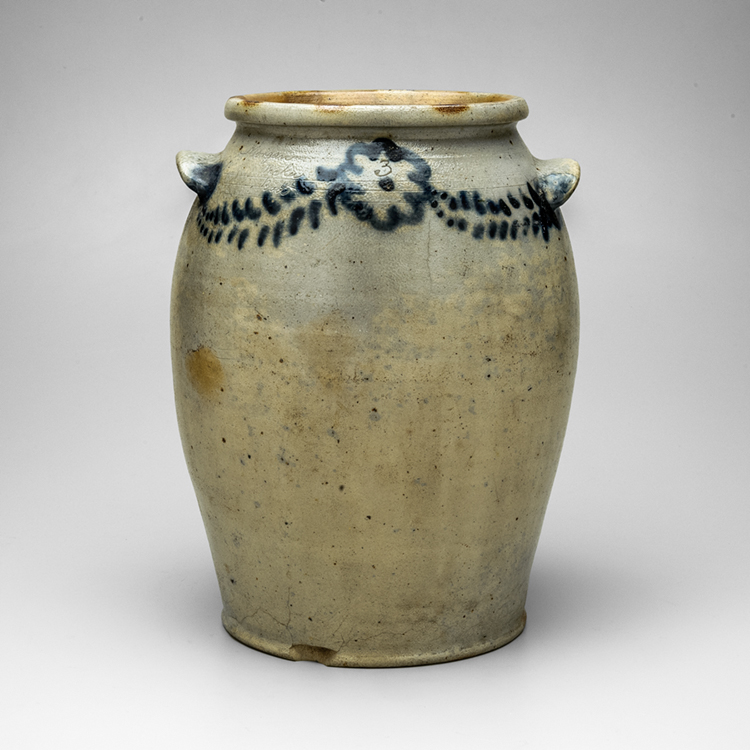
Salt glazing is a technique used by stoneware potters to create the glassy surface. When the pottery kiln reached over 2000 degrees Fahrenheit, salt was introduced to the kiln, creating a vapor. This vapor adhered to the silica in the clay, forming a glass. From the high temperature, the clay is often non-porous, or vitrified. This, combined with the salt glazing, allowed the potters to not have to apply a glaze to the interior of the vessel. It could hold liquids and not seep, unlike earthenware storage vessels.
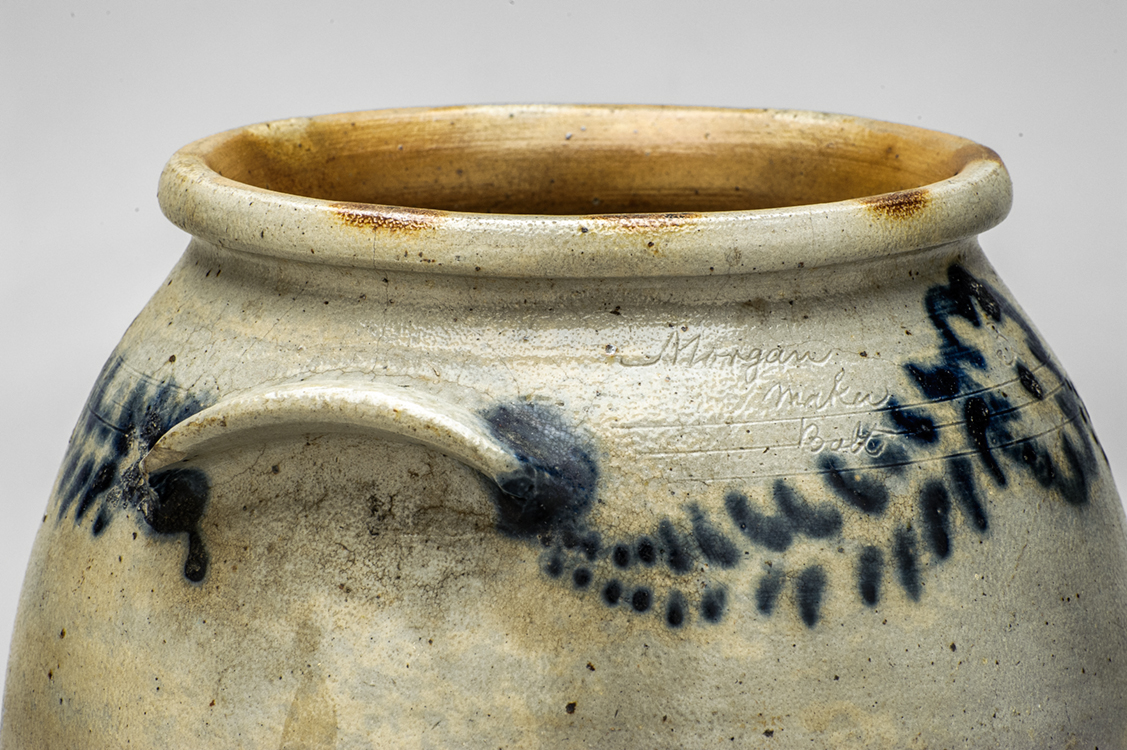
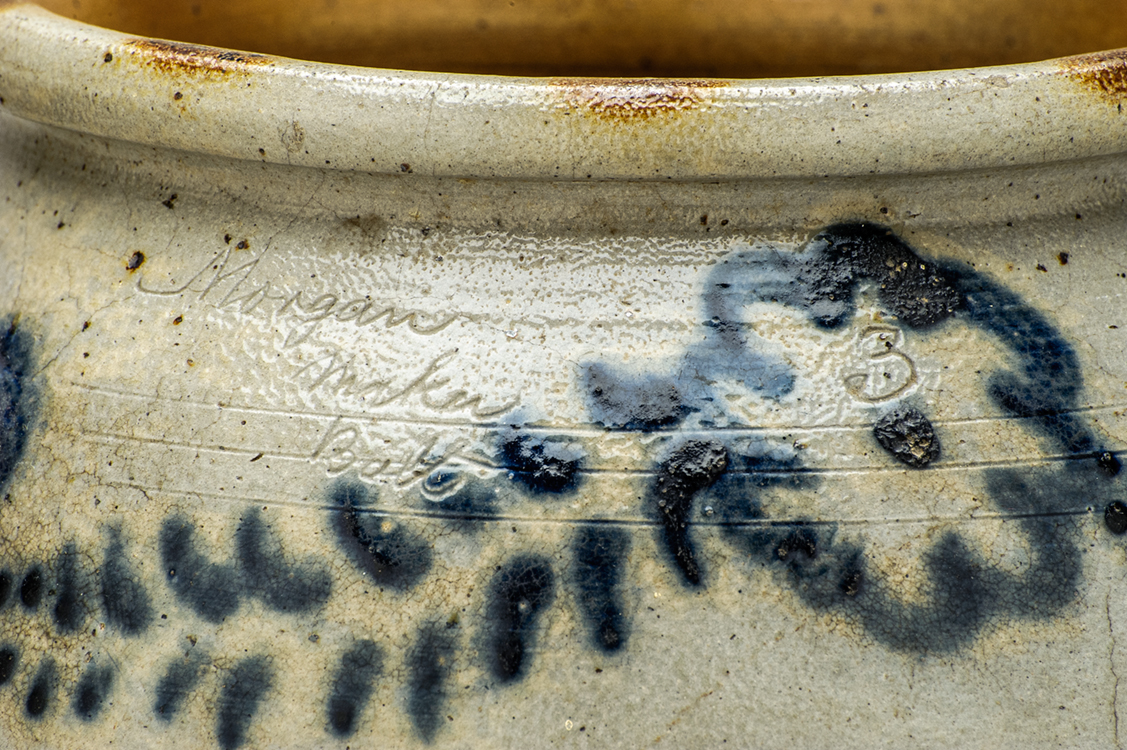
MAKER: William H. Morgan (1796-1864) appears to have partnered with his father Thomas Morgan (1768-1842) during 1823-1825. A Quaker, Thomas Morgan’s marriage to Sarah Amoss at Little Fall Friends Meeting in Harford County, Maryland, on October 10, 1795, created one of the leading stoneware potting families in the early South. In 1794, Morgan bought land for his pottery at the corner of Pitt and Green Streets in downtown Baltimore, adding to it in 1795 and 1796. He formed several partnerships with his brothers-in-law, potters Thomas (1786-1822) and William H. Amoss (1782-1857), and probably trained them. Between 1818 and 1823 William H. Morgan worked with his uncle, Thomas Amoss. After the dissolution of their partnership in 1823, Morgan continued to make pottery until 1827 at the site of his father Thomas Morgan’s shop. The Morgan and Amoss families were among the most prolific stoneware makers in Federal Baltimore; however, 1827 was the last year that William H. Morgan was listed as a potter in the Baltimore city directories.
Kille, John E. “Distinguishing Marks and Flowering Designs: Baltimore’s Utilitarian Stoneware Industry.” CERAMICS IN AMERICA (2005) 93-132.