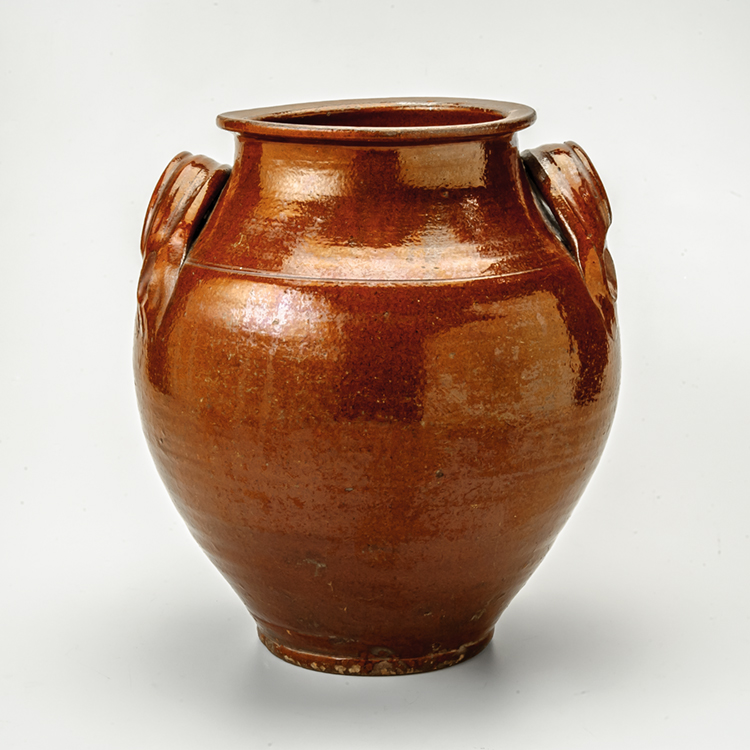
Jar
Many potters lived and worked near the Virginia towns of Abingdon and Wytheville, county seats along the Great Road leading from southwest Virginia to East Tennessee. Large clay deposits near both of these towns influenced potters’ choices of these sites. Their pottery has often been confused with the the North Carolina Moravians of Wachovia because of similar shapes, but until recently, few connections have existed between Moravian potters and the potters who worked in this area.
MAKER: Johann Christian Buck (1769-1846) was born in Pennsylvania, but moved to North Carolina as a child with his family around 1780. Growing up on the Brushy Fork of Abbot’s Creek in present-day Davidson County, he would have been exposed to the Germanic potting traditions established by the nearby Moravians at Wachovia and the Albright/Loy family in Alamance County. In 1796, he moved to Wythe County, Virginia, married Christina Steffey, and established a family of potters that worked throughout the 19th century. Buck’s 1815 tax record noted that he owned a 366-acre farm on the south fork of Reedy Creek in Wythe County with three cabins, a small barn, and a potter’s kiln. Two of his sons, Abraham Buck (1798-1863) and John Christian Buck (1801-1879); his son-in-law Eli Cain (1815-1880); and three of his grandsons, Peter Buck (1826-1880), Felix Buck (1827-1889), and Ephraim Buck (1833-1909), were all identified as potters in US census records.
Moore, J. Roderick. “Earthenware potters along the Great Road in Virginia and Tennessee.” The Magazine Antiques, September 1983.