
Jar

Artist/Maker
Duche, Andrew
Place Made
Charleston or Savannah, Georgia South Carolina United States of America
Date Made
1736-1743
Medium
earthenware –lead-glazed
Dimensions
HOA: 13 1/16″; WOA: 10 1/2″; DIA: 6″
Accession Number
3440
Description
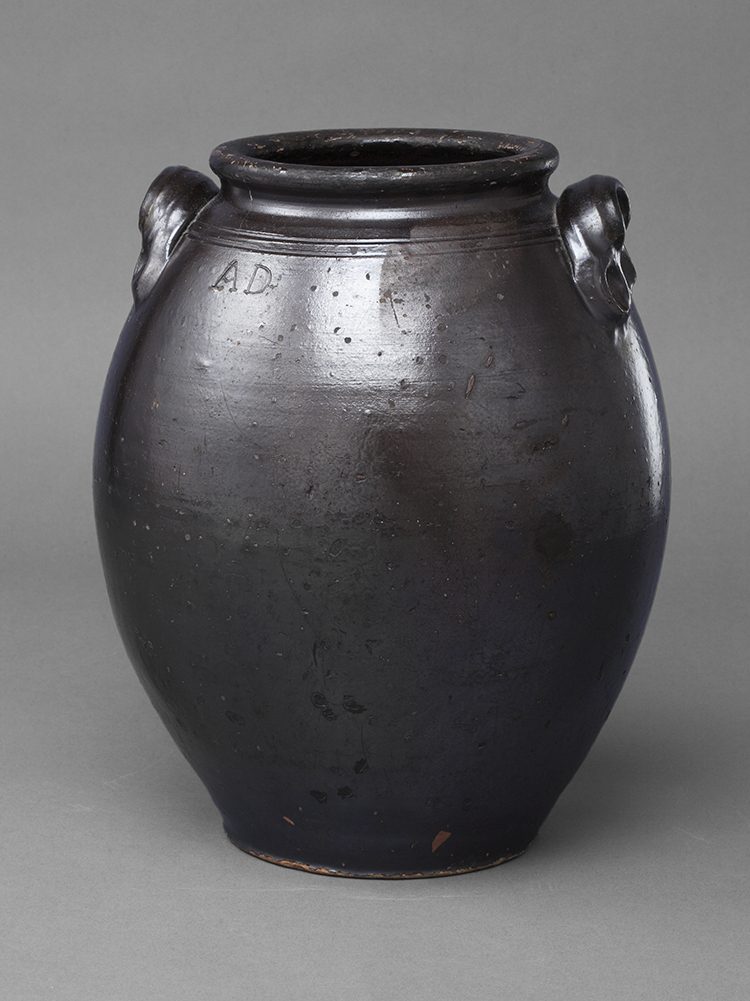
Lead-glazed and made of a buff earthenware clay, this bulbous and gracefully shaped jar has a lightly tooled foot. The jar is glazed on the interior and the exterior. The glaze is a very dark color. A lead glaze was made up primarily of a lead oxide, most often red lead, that was ground, mixed with a clay so that the mixture would adhere to the pottery, and liquified with water. Earthenware is a porous material and must have an applied glaze in order to hold liquids. This jar has a thick, rounded rim and incised lines below the neck. Thrown on a wheel, the jar has two thick, pulled strap handles resting on either side of the shoulder. There are indentations at each handle terminal and an impressed stamp “AD” on one side along the shoulder.

The chevron-like crossbar in the A is similar to an “AD” stamp used on pottery made by Anthony Duche, Andrew’s father, but also resembles other early European text and decorative arts. Though this jar was likely made in Savannah as Duche spent a longer period of time there, he has also been documented as making pottery in Charleston, South Carolina, between 1734 and 1735.

MAKER: Andrew Duche (1710-1778) was the son of a famous Philadelphia potter, Anthony Duche. Anthony (c. 1682 – 1762) had established a “Pott-House” on Chestnut Street in Philadelphia by 1725. Andrew Duche is the earliest documented potter south of Virginia. On April 5, 1735, he advertised in the South Carolina Gazette: “butter pots, milk-pans, and all other sorts of Earthen ware of this Country make… at much cheaper rate than can be imported.” Duché’s residence in Charleston was relatively brief, and in August 1736, he began renting a house in Savannah, Georgia. Duche arrived in Savannah, Georgia in 1736 and completed construction on his pottery business in 1738. Under the patronage of General James Edward Oglethorpe (1696-1785), Duché “completed his Pot Works in 1738.” Duché continued to produce utilitarian earthenware and stoneware at his Savannah manufactory, while simultaneously attempting to make porcelain. Through a mire of ill-fated ventures and financial difficulty, Duche likely continued his pottery business until 1743. William Ewen took over Duche’s Savannah pottery at least until 1755. Andrew Duche, after a move to Norfolk, Virginia, returned to Philadelphia in 1769.

Rauschenberg, Bradford L. “Andrew Duche: A Potter ‘a Little Too Much Addicted to Politicks’” MESDA Journal, Volume 17, no. 1, May 1991.
History
Discovered in northern Florida, MESDA’s earthenware storage jar is stamped “AD” and may have been made at Andrew Duche’s Charleston or Savannah pottery. Aside from this jar, the only other ceramics associated with Duché are stoneware sherds from the Frederica archaeological site at St. Simon’s Island, Georgia. Excavations at the pottery site of Anthony Duche of Philadelphia (Andrew’s father) revealed several stoneware shards with the letters “A D” impressed within a cartouche. Although the mark on this example differs from the stamp employed by Andrew Duche’s father, both make use of the early form of the letter “A” with a chevron crossbar.
Artist Biography
MAKER: Andrew Duche, the third son of potter Anthony Duche, Sr. (active 1724-1762), worked in his father’s Philadelphia factory prior to moving to Charleston, S.C. in the early 1730s. The 5 April 1735 South Carolina Gazette mentioned Andrew producing eartheneare at his “pot-house on the Bay.” Soon after this advertisement, Andrew moved to New Windsor, near Augusta, Georgia, on the Savannah River. In 1736, he moved to Savannah in order to solicit financial support, through General Oglethorpe, for his pottery. By 1738, Duche had completed the construction of his kiln. During the period from 1738-1748, Andrew Duche repeatedly claimed to have “…found out the true manner of making porcelain or china ware,” and continually sought funding from England. To date, though, no example of porcelain can be attributed to Duche.
Credit Line
Gift of Frank L. Horton