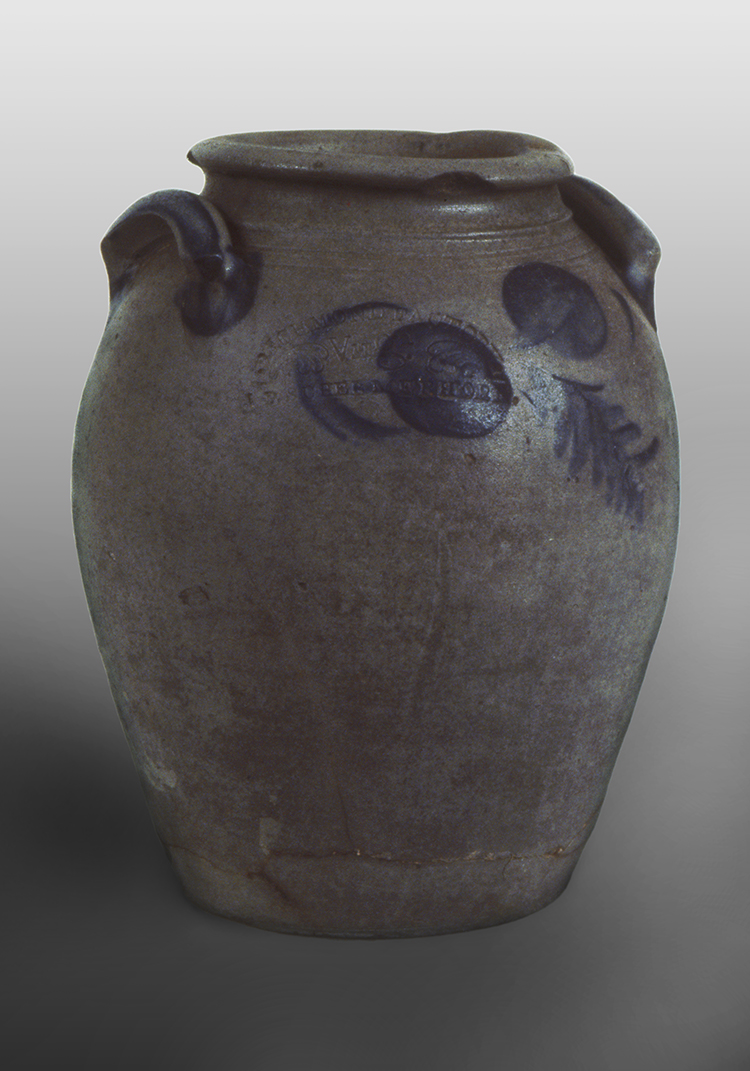
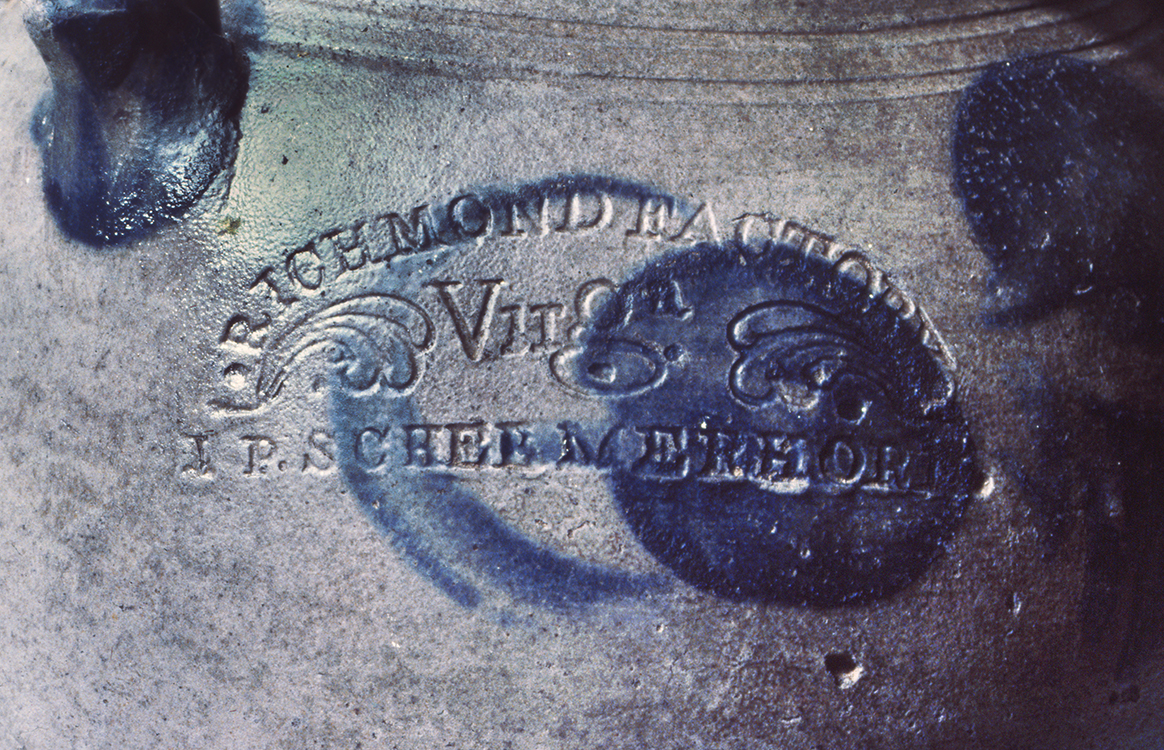
Jar
Salt glazing is a technique used by stoneware potters to create the glassy surface. When the pottery kiln reached over 2000 degrees Fahrenheit, salt was introduced to the kiln, creating a vapor. This vapor adhered to the silica in the clay, forming a glass. From the high temperature, the clay is often non-porous, or vitrified. This, combined with the salt glazing, allowed the potters to not have to apply a glaze to the interior of the vessel. It could hold liquids and not seep, unlike earthenware storage vessels.
MAKER: Born in New York, John Poole Schermerhorn (1788-1850) first appeared in Virginia records as a potter in 1814. Schermerhorn was briefly employed at Benjamin DuVal’s factory before leaving to pursue pottery production under his own name in 1817. He located his pottery at Rockett’s, a primary port in Richmond, Virginia and was very successful between 1817-1837. Schermerhorn had an additional pottery located outside of Richmond at Montezuma, established in 1828.
Russ, Kurt C. and W. Sterling Schermerhorn. “Rockett’s Red Glare: John P. Schermerhorn and the Early Richmond-Area Stoneware Industry.” CERAMICS IN AMERICA (2005) 61-92.
Russ, Kurt, Robert Hunter, Oliver Mueller-Heuback, Marshall Goodman. “The Remarkable 19th-Century Stoneware of Virginia’s Lower James River Valley.” CERAMICS IN AMERICA (2013) 200-258.