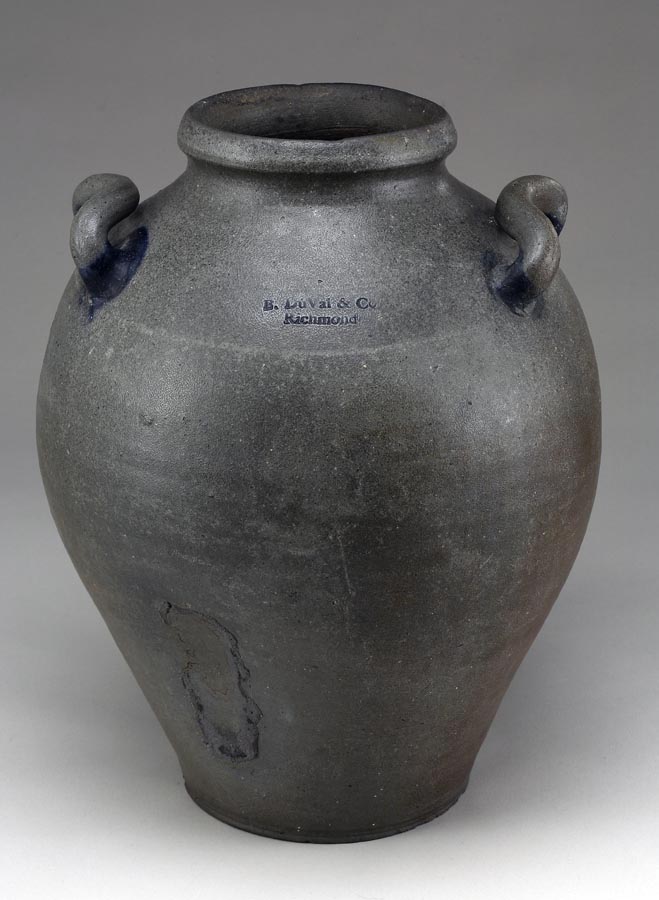
Jar
Salt glazing is a technique used by stoneware potters to create the glassy surface. When the pottery kiln reached over 2000 degrees Fahrenheit, salt was introduced to the kiln, creating a vapor. This vapor adhered to the silica in the clay, forming a glass. From the high temperature, the clay is often non-porous, or vitrified. This, combined with the salt glazing, allowed the potters to not have to apply a glaze to the interior of the vessel. It could hold liquids and not seep, unlike earthenware storage vessels.
STYLE: This jar probably dates between 1811, when the stoneware manufactory was begun, and 1817, when James DuVal succeeded his father in the business. Shapes produced at the Benjamin DuVal factory are similar to forms made in New York. Much of DuVal’s known factory work has minimal cobalt blue slip decorations. Among archaeology salvaged from DuVal’s factory site as well as in his advertisements, jars were among the most commonly made item in his shop
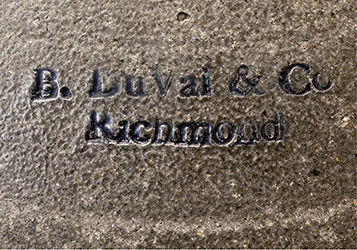
MAKER: Benjamin DuVal was not himself a potter, but oversaw the production of stoneware at his factory. As early as 1808, Benjamin DuVal’s pottery was producing clay roofing tile and by 1811 had expanded production to include salt-glazed stoneware pottery. As of the 2013 Ceramics in America publication which published new research on DuVal’s pottery site, there were fewer than ten known signed pieces of DuVal’s work to survive intact. In an 1814 advertisement, DuVal noted an association with John P. Schermerhorn (1788-1850) and his pottery factory, stating that Schermerhorn “is concerned in one of my shops.” DuVal’s inventory also suggests that “a number of slaves might have been employed in the operation”
Rauschenberg, Bradford L. “B. DuVal & Co./Richmond: A Newly Discovered Richmond Pottery.” Journal of Early Southern Decorative Arts (1978) 45-75.
Russ, Kurt, Robert Hunter, Oliver Mueller-Heubach, Marshall Goodman, “The Remarkable 19th-Century Stoneware of Virginia’s Lower James River Valley.” CERAMICS IN AMERICA (2013) 200-258.
Hunter, Robert and Marshall Goodman. “The Destruction of the Benjamin DuVal Stoneware Manufactory, Richmond, Virginia.” CERAMICS IN AMERICA (2005) 37-60.