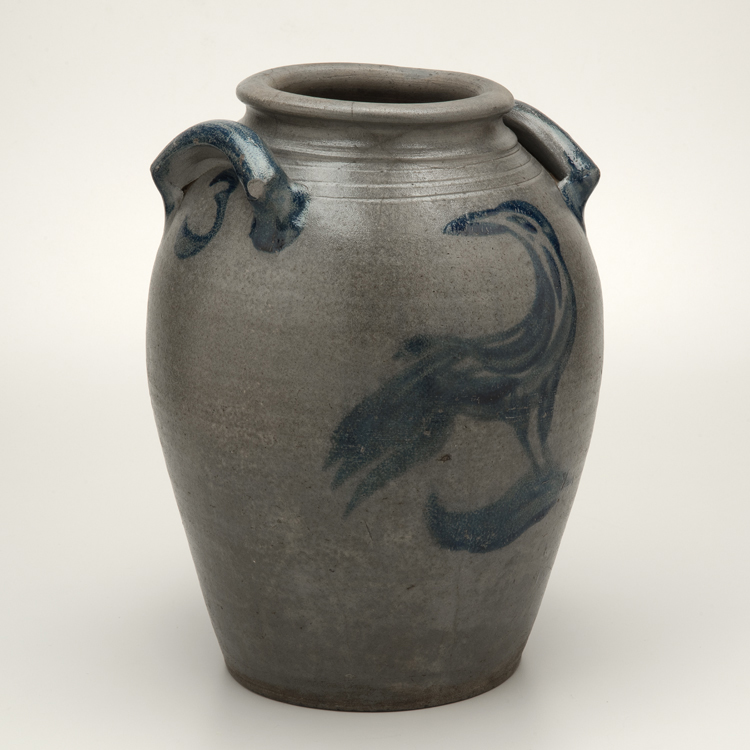
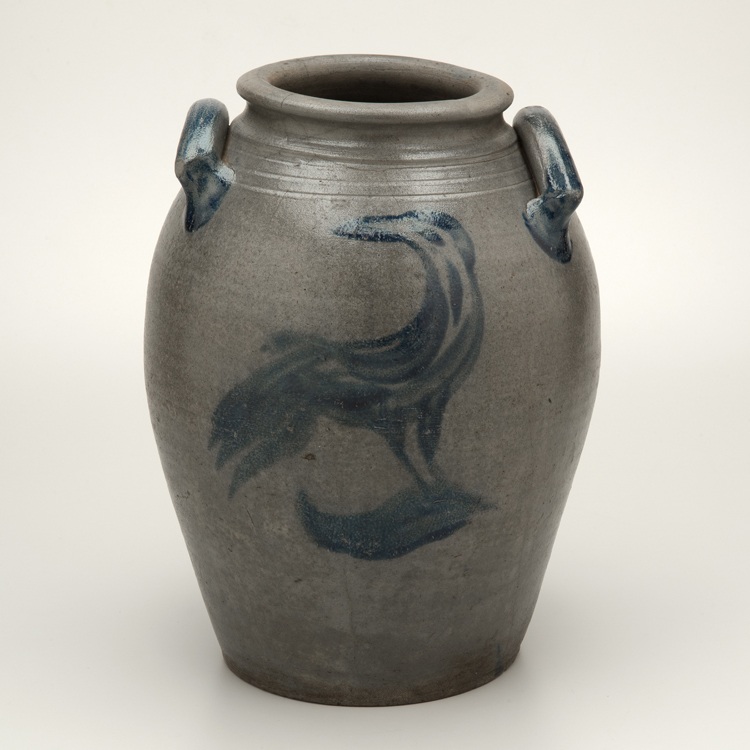
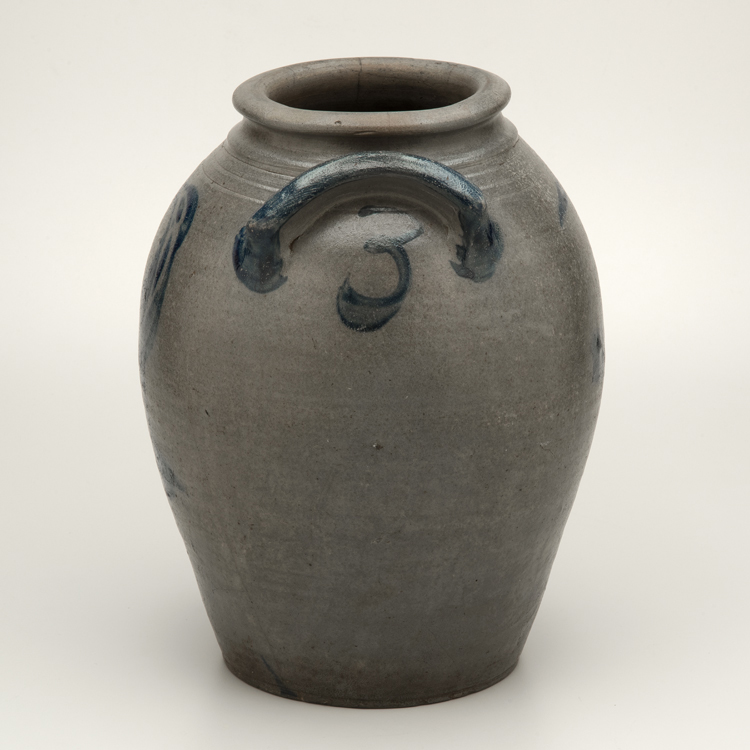
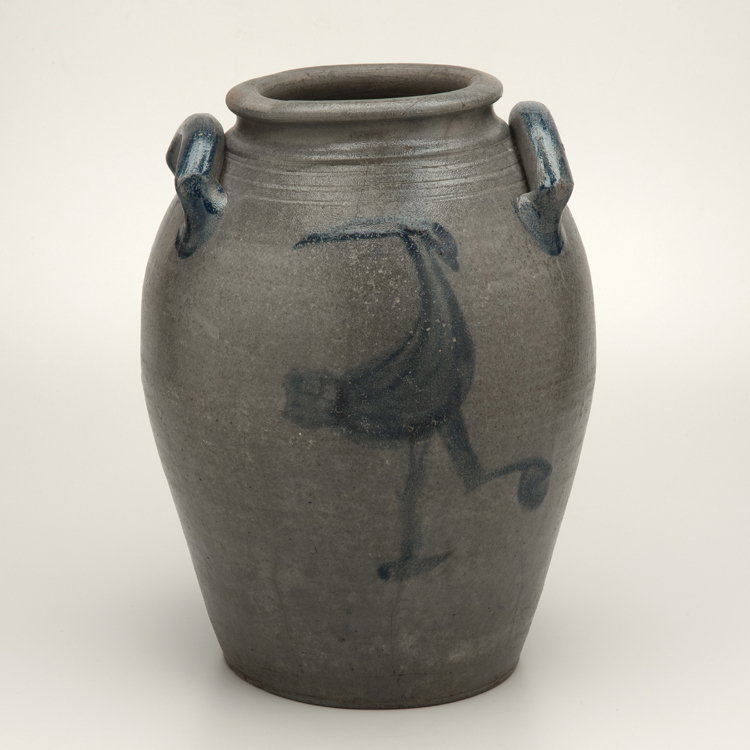
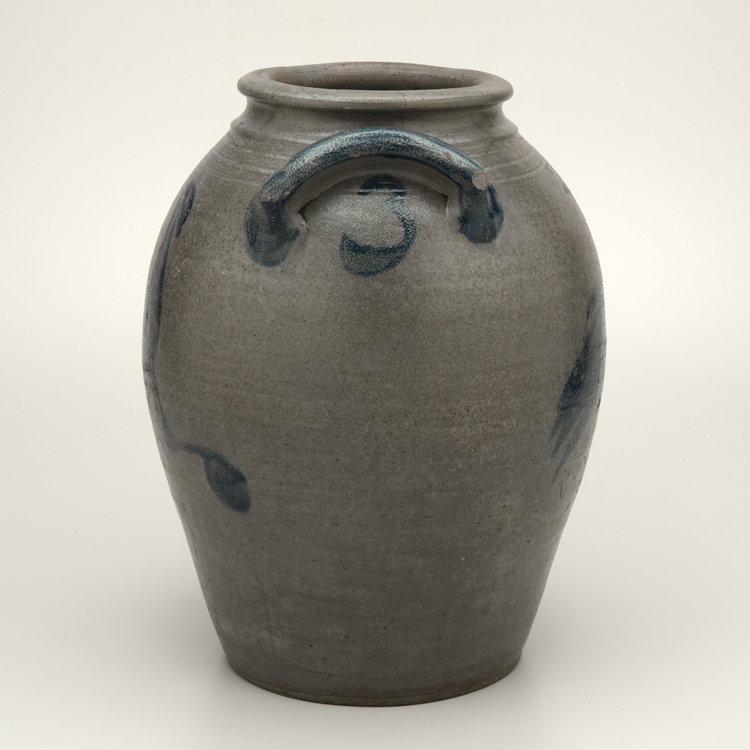
Jar
Salt glazing was a technique used by stoneware potters to create a glassy surface. When the pottery kiln reached over 2000 degrees Fahrenheit, salt was introduced into the kiln, creating a vapor. This vapor adhered to the silica in the clay, forming a glassy appearance on the pottery. Because of the the high temperature at which the pottery was fired, the clay often became non-porous, or vitrified. This, combined with the salt glazing, meant that potters did not have to apply a glaze to the interior of the vessel. It could hold liquids and not seep, unlike earthenware storage vessels.
MAKER: Born in New York, John Poole Schermerhorn (1788-1850) first appeared in Virginia records as a potter in 1814. Schermerhorn was briefly employed at Benjamin DuVal’s factory before leaving to pursue pottery production under his own name in 1817. He located his pottery at Rockett’s, a primary port in Richmond, Virginia, and was very successful for 20 years– between 1817 and 1837. Schermerhorn had an additional pottery located outside of Richmond at Montezuma, established in 1828. This jar was produced in either the Richmond or Montezuma shop, both in Henrico County.
Russ, Kurt C., Robert Hunter, Oliver Mueller-Heubach, and Marshall Goodman. “The Remarkable 19th-Century Stoneware of Virginia’s Lower James River Valley.” CERAMICS IN AMERICA (2013): 200-258.