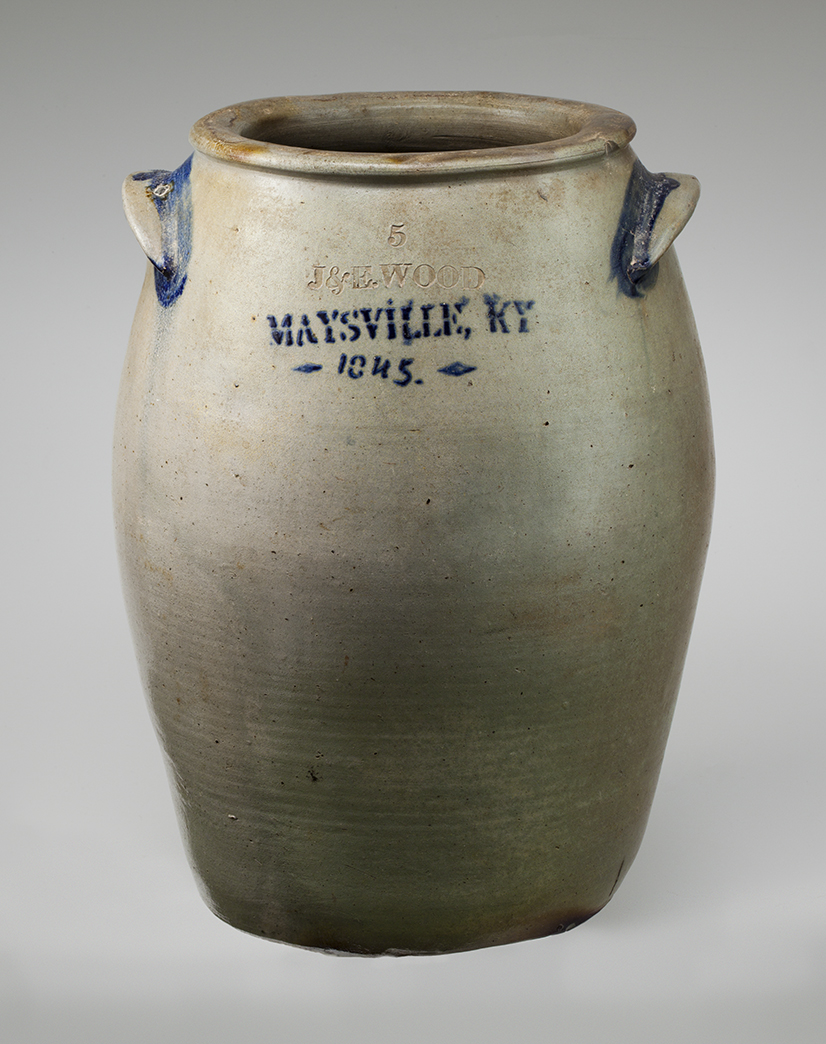
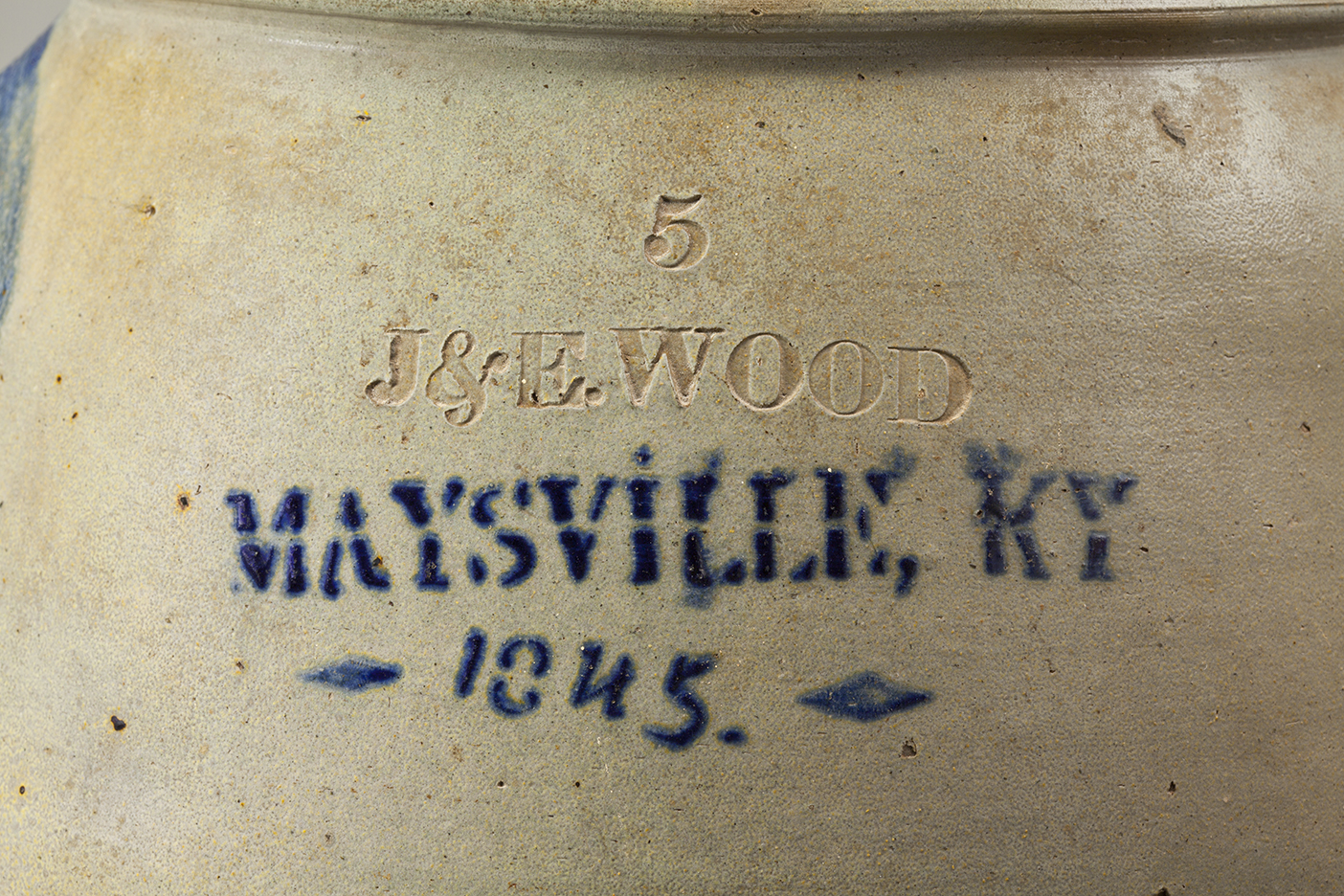
Jar
Salt glazing is a technique used by stoneware potters to create the glassy surface. When the pottery kiln reached over 2000 degrees Fahrenheit, salt was introduced to the kiln, creating a vapor. This vapor adhered to the silica in the clay, forming a glass. From the high temperature, the clay is often non-porous, or vitrified. This, combined with the salt glazing, allowed the potters to not have to apply a glaze to the interior of the vessel. It could hold liquids and not seep, unlike earthenware storage vessels. Evidence on the pottery reveals the nature of stacking used inside of the kiln in order to fire the vessels. In firing a salt-glazed stoneware kiln, kiln furniture is necessary as a buffer between the pieces of pottery in order to keep the glass created by the salt firing from adhering the vessels to one another. Kiln furniture was often made with the same clay as the vessels, sometimes with additional grog or sand mixed in, and then rolled in sand in order to further protect the vessels. This jar has five curved kiln furniture markings on the base and five curved markings on the rim, implying that curved bars protected the vessel when placed between two other vessels stacked inside of the kiln. Small remnants of sand on the base of the vessel near the shadows of kiln furniture implies that Wood’s kiln furniture had a heavy application of sand, or a heavy application of salt in the kiln causing the sand to stick to the vessel.
MAKER: John Thomas Wood, born in 1808, died in 1864 in Kentucky, while his brother Ezekiel, born in 1817, died in 1900 in Boone County, Missouri. An 1883 publication from St. Louis, Missouri described Ezekiel Wood as a “successful farmer, and is well–to-do in life.” It goes on to state, that farming was not the only industry he followed, “He was engaged in ‘flat-boating’ to and from New Orleans for some time in an early day, and later he was a manufacturer of stoneware” (St. Louis National Historical Company, History of Howard and Cooper Counties, (St. Louis: National Historical Company, 1883): 543-568. ) The 1850 census of manufacture also reveals that Jesse Wood (1779-1857), the father of John and Ezekiel, was also a potter in Maysville.