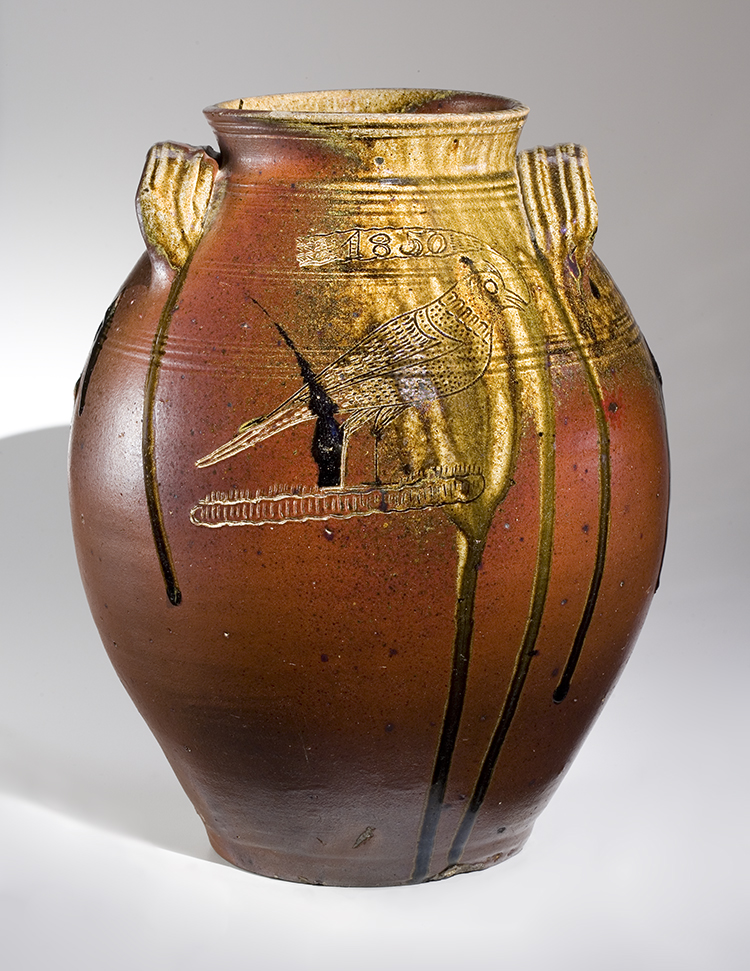
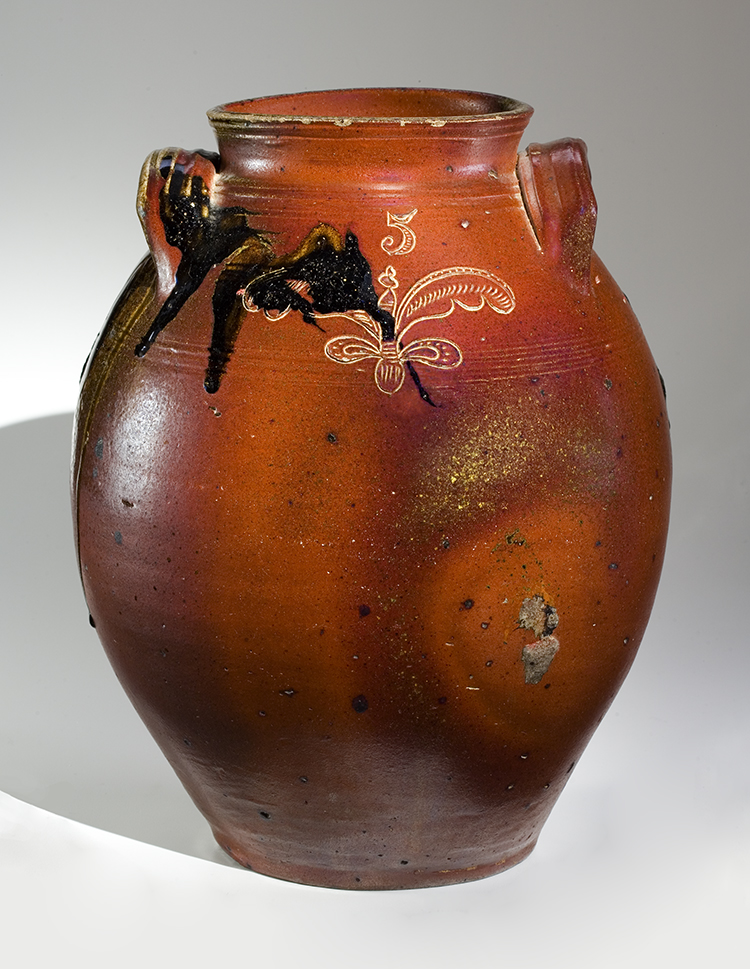
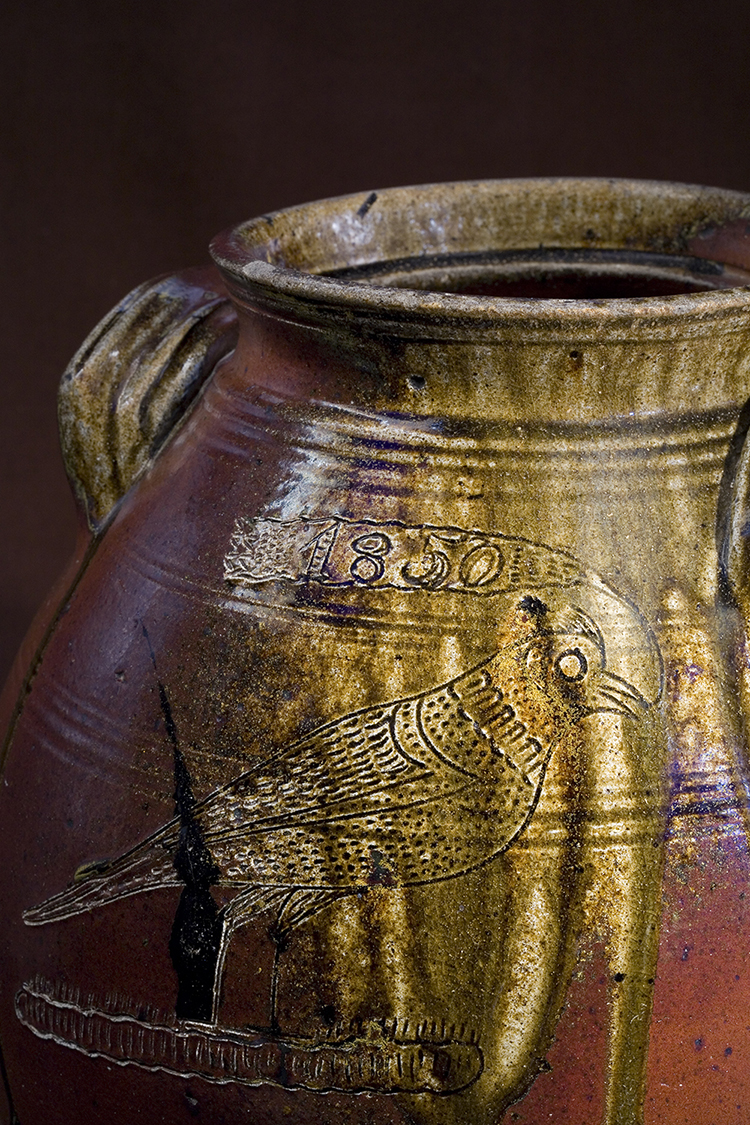
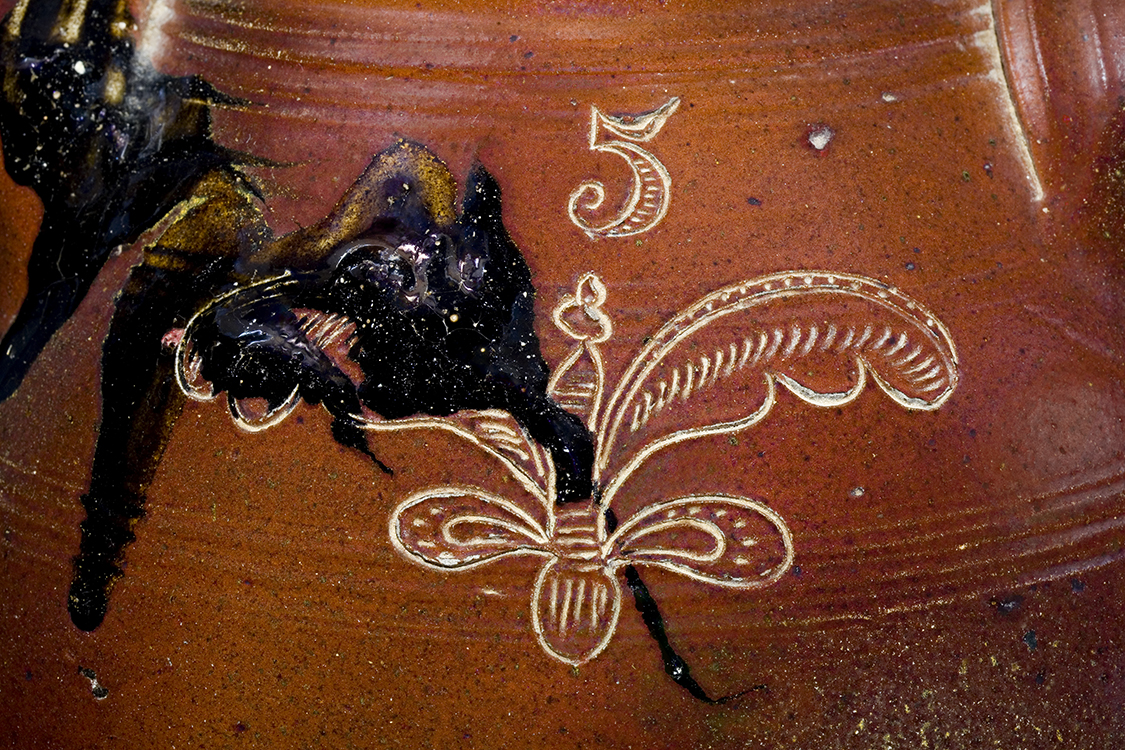
Jar
Salt glazing is a technique used by stoneware potters to create the glassy surface. When the pottery kiln reached over 2000 degrees Fahrenheit, salt was introduced to the kiln, creating a vapor. This vapor adhered to the silica in the clay, forming a glass. From the high temperature, the clay is often non-porous, or vitrified. This, combined with the salt glazing, allowed the potters to not have to apply a glaze to the interior of the vessel. It could hold liquids and not seep, unlike earthenware storage vessels.
MAKER: Born in 1799, Chester Webster was one of several family members who were employed at pottery factories in the Hartford, Connecticut area. Chester Webster moved to North Carolina in 1827, likely joining his brother Edward in Fayetteville before moving to Randolph County. The 1840 census in Randolph County shows Chester Webster and brother Timothy Webster in residence there. Chester Webster did not purchase any land, and was likely working with members of the Craven family in their pottery operations. By the 1850s, Chester Webster was working with Bartlett Yancy Craven, the son of Solomon Craven. B.Y. Craven, as he was known, ran a general store, for which the account book from 1853-1869 survives in the collection of Duke University. Chester Webster appears in the account book for various credits from his work, including making pottery and being credited by the gallon of ware thrown on the wheel. In 1857, Chester made between 3 and 4 cents per gallon. Quincy Scarborough noted that in September of 1857 a note was made for Webster’s work, “that he had turned 1215.75 gallons, averaging 173.68 gallons on each of the seven days he worked.”
Scarborough, Quincy and Samuel Scarborough. “The Webster School of Folk Potters.” Fayetteville, NC: privately published, 1986 and 2009.
Scarborough, Quincy. “The Webster School of Folk Potters.” Journal of Early Southern Decorative Arts (1984) 36-37.