Jacob Foust
ARTIST: The “Guilford Limner” is the working name assigned to an unknown watercolor artist, most of whose attributed works were painted in Guilford County, North Carolina in 1826 and 1827. Typical features of the Guilford County likenesses include faces with large, luminous eyes with eyelashes, decorative architectural backgrounds, and sitter names and dates inscribed in block lettering. Later North Carolina portraits, probably painted between 1828 and 1832, are of subjects living in Mecklenburg, Iredell and Rutherford Counties. These differ from the Guilford County portraits in that they do not include decorative interiors or inscribed names, but do include a radiating background behind the figures.
In addition to the North Carolina portraits, nineteen examples of the Limner’s work have been identified with Kentucky histories from Breckenridge, Clark, Bourbon, Franklin, Green, Washington and Lincoln Counties, dated between 1818 and 1825, providing ample evidence that the artist worked in Kentucky before coming to North Carolina. Five South Carolina portraits are known, three of subjects from Union County (Spartanburg), and two from Fairfield County, the latter of which are dated 1832, confirming the Guilford Limner’s working dates from 1818-1832.
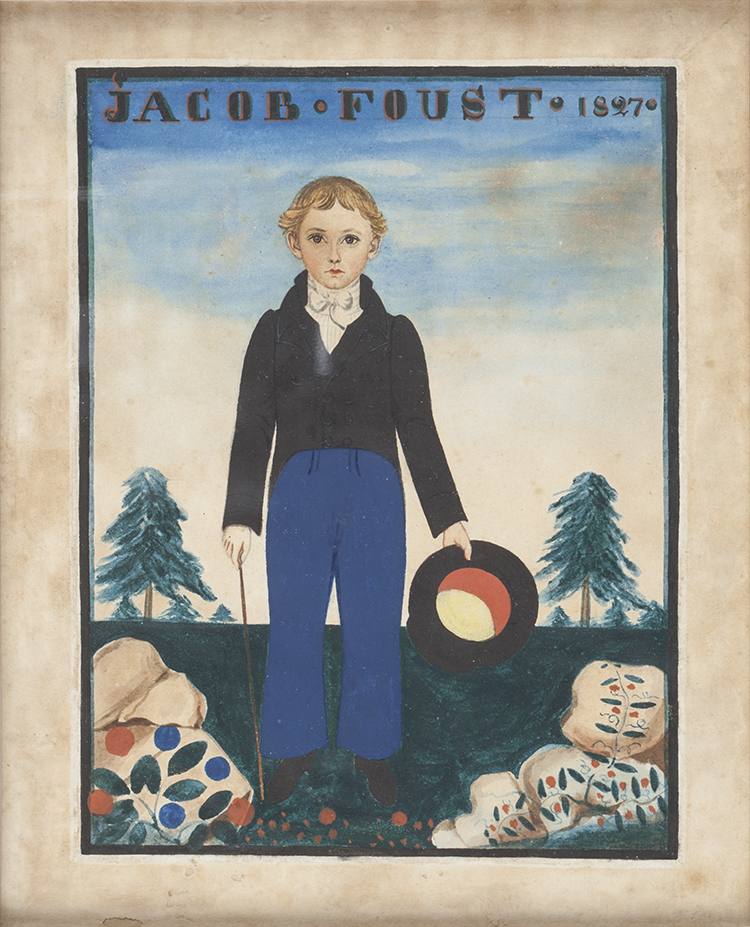
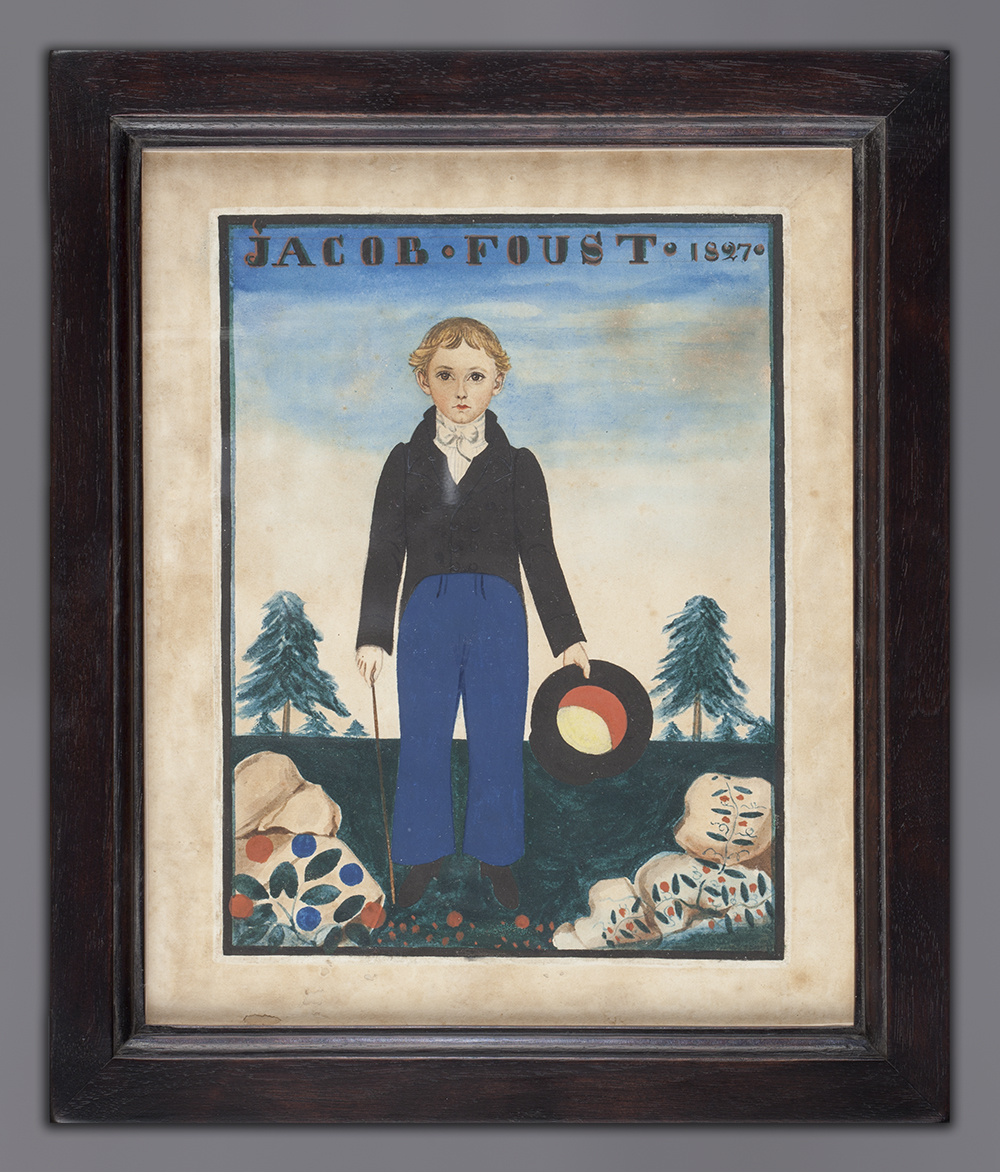
DESCRIPTION: Watercolor portrait of Jacob Foust, 1827. Portrait of a young man in a exterior setting with pine trees on either side and white rocks to left and right with vines, leaves, tendrils and red and green and blue round fruit or berries. The figure is centered, focusing forward wearing black coat, blue trousers, black shoes, holding a cane in the hand to the left and a top hat in the hand to the right. Above the figure the sitter’s name and the date are inscribed in large block letters in painted in black and outlined with red. Pencil lines defined the upper and lower edges of the inscription.
RELATED OBJECTS: One of three Foust family portraits by the Guilford Limner, two of which–Jacob and Mary (Clapp) Foust–are at MESDA (5753.1-2). Daniel Foust, Mary’s husband and Jacob’s father, is in a private collection. A reproduction of Daniel’s portrait is at MESDA. MESDA’s sulfur-inlaid chest of drawers (MESDA acc. 5568) was owned by Daniel Foust’s parents George Foust (1756-1836) and his wife Barbara (Kivett) Foust (1761-1837)
In the nearly forty known examples, sitters’ names frequently appear below their likenesses or in the backgrounds, and dated works range from 1820 to 1827. The North Carolina subjects were successful merchants, plantation owners, and their families, most of whom were related, knew one another, and lived within a five-mile radius of Greensboro. Adults are seated indoors, facing forward or in three-quarter poses. Some male subjects sit cross-legged, while others are seated at tables, writing letters or attending to business accounts. Women often hold handkerchiefs, books, or knitting implements. Children usually stand indoors, or are posed outdoors in landscape or garden settings. Carefully rendered faces are distinguished by large eyes with oversize irises. Hands did not intimidate the artist, for they appear in all the known portraits. Plants are prominent, including flowering vines that flank or arch over some sitters, as well as trees, rosebushes, cut flowers, and, in one instance, ears of corn.
Room furnishings are an integral part of many portraits, making the works valuable records of early-nineteenth-century North Carolina domestic tastes. Adults and youths are seated in painted and gilded fancy chairs, and one elderly subject sits in a turned armchair. Patterned carpets or floor cloths, candle stands, and drop-leaf tables are standard props. Wainscoting and chair rails brightened by faux marble decoration painted in vivid, contrasting hues also appear frequently.
The most vexing question about the Guilford Limner, besides the artist’s identity, regards the source or inspiration for these compositions. Portraits by the Canadian watercolor artist, Thomas Macdonald (c. 1784–1862), come to mind, but it is unlikely that their paths crossed. No body of work of comparable size, originality, or technical proficiency from this period painted in America is known. One explanation, which the two references to the artist may support, is that the Guilford Limner was foreign-born and introduced a new style of portraiture to America.
See also Painting, American Folk; Watercolors.
BIBLIOGRAPHY
Carroll, Karen Cobb. Windows to the Past: Primitive Watercolors from Guilford County, North Carolina, in the 1820s. Greensboro, N.C., 1983.
Little, Nine Fletcher. Little by Little: Six Decades of Collecting American Decorative Arts. New York, 1984