Hazen Kimball
ARTIST: Joseph-Pierre Picot de Limoëlan de Clorivière (1768-1826). He was born into a noble family in Brittany, France. Educated at the Royal Military Academy, he was an officer in the French army under Louis XVI until the Revolution cut his reign short. A royalist, he was part of a conspiracy to assassinate Napoleon in 1800. A wanted man, he fled to America accompanied by his sister and brother-in-law John Baptiste Mark Michael de Chappedelaine in 1803. Chappedelaine was heir to extensive American property, including parts of Sapelo and Jekyll Islands, a mill in New Jersey, assorted assets in Rhode Island, and land in Ohio. Returning to France later that year, Chappedelaine left his brother-in-law in charge of settling his inheritance.
In late 1803 Clorivière advertised in Savannah that: “MR. CLORIVIERE OFFERS his talents IN MINIATURE PAINTING to the Ladies and Gentlemen who desire their Likenesses. Price twenty-five Dollars…” In addition to the Savannah River Valley, Clorivière also painted in Kentucky, Ohio, and Washington, D.C. while he pursued his brother-in-law’s legal claims. In 1806 he advertised in Baltimore. His work is often signed “Picot” or “Picot Clorivière.”
A devout Catholic, Clorivière had corresponded with Bishop John Carroll (1735-1815) in Baltimore as early as 1803 about the lack of priests in America. Five years later, after settling his brother-in-law’s affairs, Clorivière entered St. Mary’s Seminary in Baltimore. He was ordained in 1812 and assigned to St. Mary’s Church in South Carolina. Following a brief return to France in 1815 he was assigned as the priest-confessor to the Sisters of the Visitation at Georgetown. During his time with the sisters he designed and oversaw construction of a number of major building projects for their monastery and its associated academy. He died in Georgetown in 1826.
REFERENCES:
Stephen C. Worsley, “Joseph-Pierre Picot de Limoëlan de Clorivière: A Portrait Miniaturist Revealed,” Journal of Early Southern Decorative Arts, Vol. XXVIII, No. 2 (Winter 2002).
https://archive.org/details/journalofearlyso2822002muse
RELATED OBJECTS: MESDA has three works by Joseph-Pierre Picot de Limoëlan de Clorivière: a portrait miniature of Andrew Green Simpson Semmes (MESDA acc. 2287.1); a portrait miniature of Hazen Kimball (MESDA acc. 5112); and a portrait miniature of John Davant (MESDA acc. 5369.3).
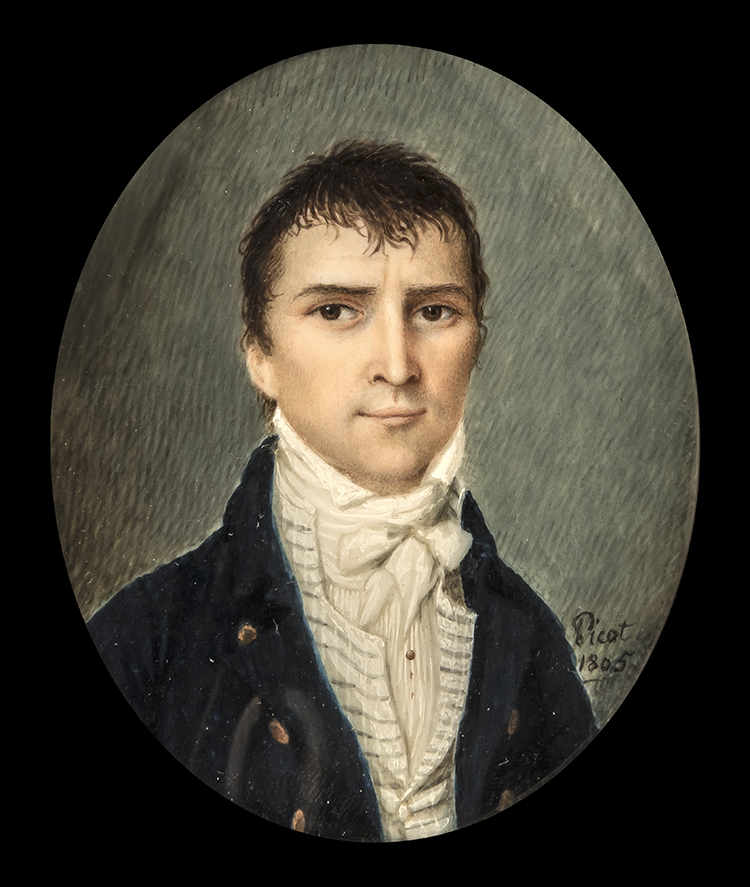
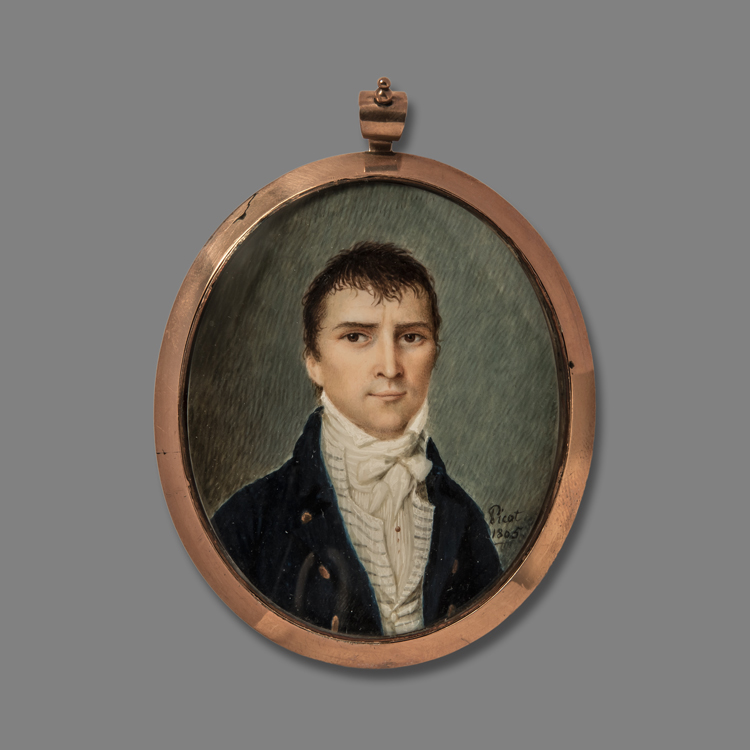
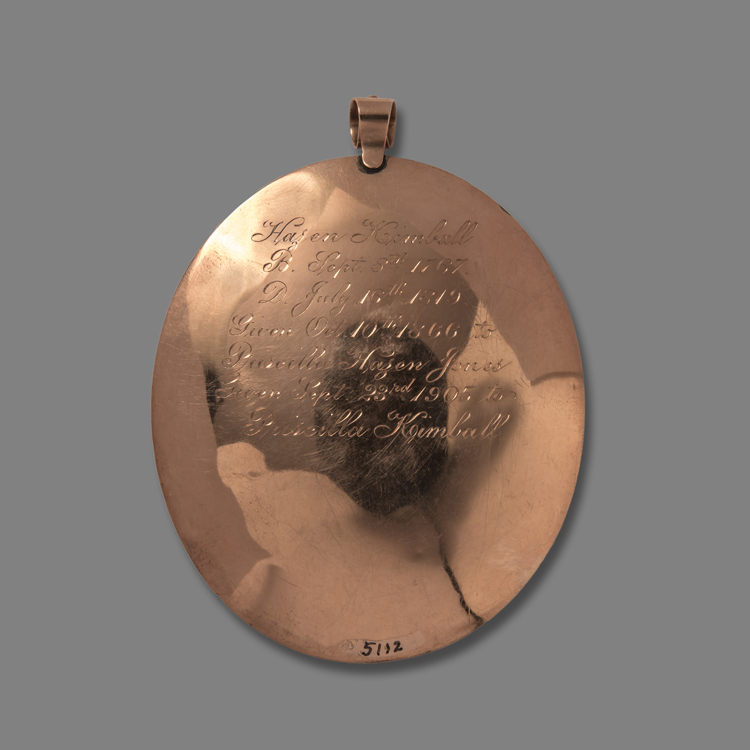
DESCRIPTION: Watercolor on ivory of Hazen Kimball. The frame is a gilded copper alloy case with engraving on the back. The case hanger has a double ball finial.The man is wearing a blue coat with five visible buttons, a shirt and cravat. He has dark brown eyes and wavy dark brown hair, which falls slightly over his forehead. “The face is painted in predominantly brown shadows, with red lines over the eyelids, and white lights in the pupil.” (Aiken Condition Report) The background of the miniature is greenish in color with shading of light brown throughout.The artist signed and dated the miniature on the lower proper left corner.