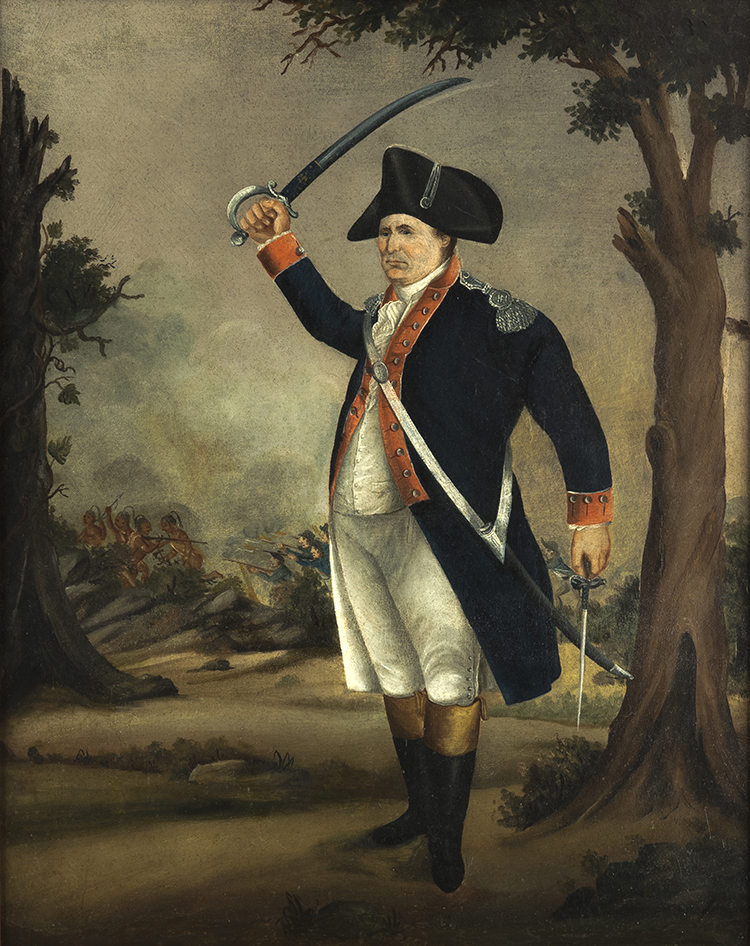
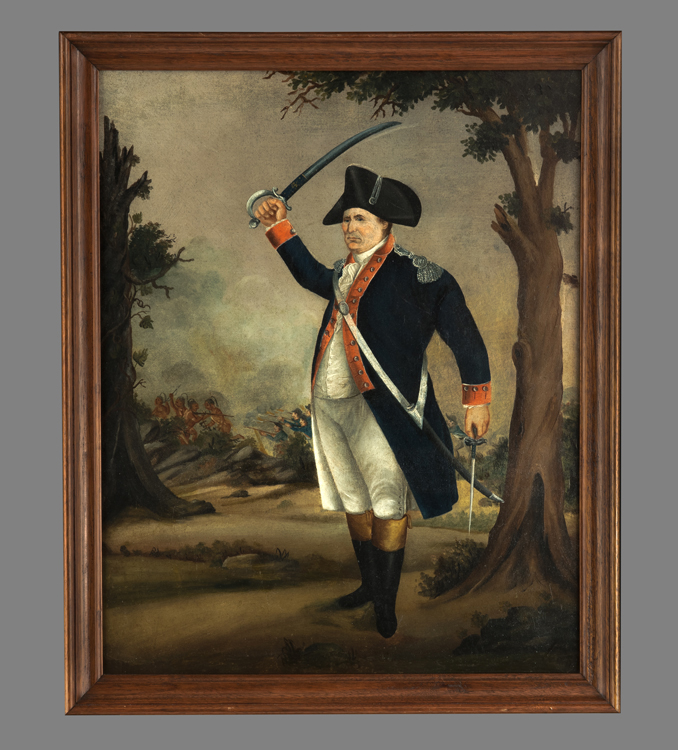
General William Darke
In 1791, he was commissioned the lieutenant-colonel in a regiment of levies and commanded the left wing of St. Clair’s army at its defeat by the Miami Indians on Nov. 4, 1791. That is the battle depicted in this painting. This portrait represents the only representation of the uniform of the state levies during St. Clair’s campaign. It was the single largest defeat of the army by native Americans to date. The loss of this battle led to the first ever congressional inquiry.
Darke died in Jefferson County, Virginia, November 26, 1801.
ARTIST: Frederick Kemmelmeyer (b.1752-1753; d.1820-1825) was a Hessian soldier and doctor. Research by A. Nicholas Powers now places Kemmelmeyer in America as early as 1776. Following the American Revolution Kemmelmeyer settled in Charleston, South Carolina, where documents suggest he married, fathered a child, and got divorced.
Sometime between 1784 and 1788 he moved to Baltimore, Maryland. He first advertised on June 3, 1788 in the Maryland Gazette that he had “opened a Drawing-School for young Gentlemen.” He later advertised as a portrait painter in miniature and watercolor and announced the establishment of “An Evening Drawing-School for the instruction of young gentlemen who many have a desire of learning that polite art.” Between 1803 and 1805 Kemmelmeyer worked in the District of Columbia.
The final years of Kemmelmeyer’s career were spent in western Maryland and the Valley of Virginia. During this period he advertised in the Hagerstown and Frederick newspapers. His last known advertisement is dated 1816.
In Charleston, Baltimore, and the Valley of Virginia, Kemmelmeyer was closely associated with the German-speaking Lutheran community.
Kemmelmeyer is best known for his military paintings featuring General George Washington including two versions of “George Washington Reviewing the Western Army…” at the Winterthur Museum (WM acc. 1958.2780) and the Metropolitan Museum of Art (MMA acc. 62.201.2) as well as his portraits of Washington (MESDA acc. 3814).
RELATED OBJECTS: The MESDA Collection includes five paintings from “Piedmont”, the house built between 1786-1890 for Dr. John Briscoe, Jr. (1752-1818), and Eleanor (Magruder) Briscoe (b.1766). These include portraits of Dr. and Mrs. Briscoe by John Drinker (1760-1826) (MESDA acc. 973.1-2); a portrait of Sarah D. Rutherford by Drinker (MESDA acc. 973.3?); and a portrait of General William Darke (1736-1801), by Frederick Kemmelmeyer (1760-1821) (MESDA acc. 973.3).
REFERENCES: A. Nicholas Powers, “Research Note: Frederick Kemmelmeyer—From Hessian Soldier to American Artist,” Journal of Early Southern Decorative Arts, vol. 34, 2013. http://www.mesdajournal.org/2013/research-note-frederick-kemmelmeyer-from-hessian-soldier-american-artist/
DESCRIPTION: Full length portrait of a man in blue uniform with red trim at lapel and cuffs, white vest and breeches with black boots trimmed with gold at the top, white epaulets and neck piece, and black tircorner hat decorated with silver cord. He is posed with sword in right upraised hand and a dagger-like knife in the left, facing half-left, with a tree at either side to frame a fight between American troops and Indians in the background. The soldiers in the back wear round hats, short blue jackets with red facings, belly boxes, and linen overalls. The retreating Indians to the left rear of the painting appear with topknots or scalp locks, and wear battle dress of breechcloths and leggings.