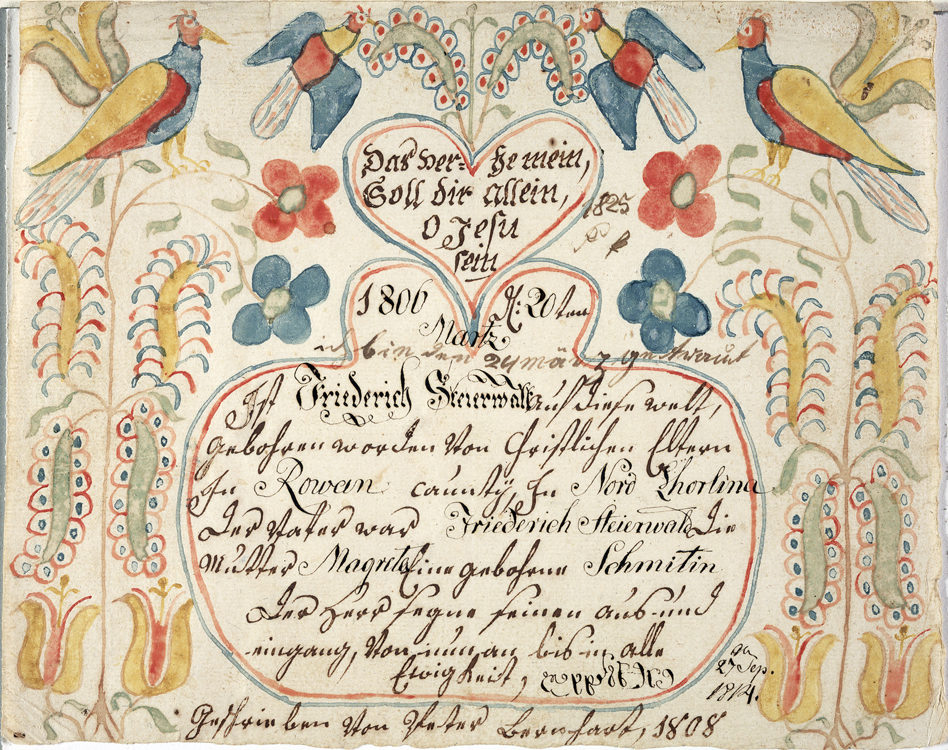
Geburtschein/Birth Certificate of Frederich Steierwalt
Inscription:
Das her=ze mein / Soll dir allein/ O Jesu / Sein.
1806 = 20 ten / Martz /
[Inserted in a different hand] 1825 / Ich bin den 24 Marz getraut /
Ist Friederich Steierwalt auf diesen welt / Gebohren worden Von Christlichen Eltern / In Rowan County in Nord Chorlina/
Der Vater war Friederich Steierwalt Die / Mutter Magrete eine gebohren Schmitin / Der Herr segne seinen aus und eingang, von nun an bis in alle Ewigkeit.
In mirror script: reneggeH H C == 27th Sep. 1814.
Geschrieben von Peter Bernhart, 1808
This heart of mine
Shall be yours alone
O Jesus.
1806, the 20th of March
[inserted in a different hand]: 1825 I was married on March 24 / was Friederick Steierwalt born into this world of Christian parents / in Rowan County, North Carolina. The father was Friedrich Steierwalt, the mother Magrete, born Schmit. The Lord bless thy going out and thy coming in from now on in eternity. [Below inscription in mirror script] C H Heggener = = 27th Sep. 1814.
[Below cartouche] Written by Peter Bernhart, 1808 [to the lower right] 27th Sep. 1814
Artist: Peter Bernhardt (w. 1794-1819). Scrivener: C. H. Hegger(en). One of the most prolific fraktur artists in the Shenandoah Valley was Peter Bernhardt of Keezletown in Rockingham County, who advertised in the August 19, 1798 Winchester Gazette: “Peter Barnhart, informs the public that the first [of] August he commenced the business of riding as Post from Winchester to Staunton, and in his route goes up through Rockingham, and carries M. Bartgis & Co.’s English and German News Papers. He leaves Winchester every Wednesday two weeks; arrives at Rockingham on Friday evening following, and the next days goes to Staunton, and from there returns to his house.”
Bernhardt’s style was heavily influenced by the work of Friedrich Krebs, a well-known fraktur artist of Dauphin County, Pennsylvania. One Krebs taufschein form was filled in by Bernhardt, which is not unusual, since artists commonly made up blank but ornamented forms to be completed at a later time, which is the case in this example. Bernhardt himself had a long association with the printer Ambrose Henkel of New Market, Virginia, who printed standard forms for the artist. This certificate for Friederich Steierwalt was written and painted by Bernhardt, signed by him, and dated 1808. The spaces for names and dates were left blank and the document was filled in by a scrivener named C. H. Hegger(en), who dated his work 27 September 1814, and signed his name in a mirror image below the inscription. The difference between Bernhardt’s hand and that of the North Carolina scrivener is obvious in both the penmanship and the ink color. Whether the inscription was completed in North Carolina or in Virginia is not known. The unusual spelling of “Carolina” as “Chorlina” suggests that this may not have been done in North Carolina!
See also:
Bivins, John and Forsyth Alexander. The Regional Arts of the Early South: A Samping from the Collection of the Museum of Early Southern Decorative Arts. Winston-Salem: Old Salem, Inc. 1991.
Earnest, Russell D. and Corinne P. Earnest. Papers for Birth Dayes: Guide to the Fraktur Artists and Scriveners. (East Berlin, Pa.: Russell D. Earnest Associates, 1997), 2nd ed., vol. 1 and 2.
Paul, Bonnie L. and Pat Turner Ritchie, editors. Bernhart & Company: Shenandoah Valley Folk Art Fraktur (1774-1850). Dayton, VA: The Heritage Museum, Harrisonburg-Rockingham Historical Society, 2011.
Wust, Klaus. Virginia Fraktur: Penmanship as Folk Art. Edinburg, Virginia; Shenandoah History, 1972.
Since this piece does not include any baptism information, it is possible that it was originally intended to be used by the Mennonite community which does not practice infant baptism.