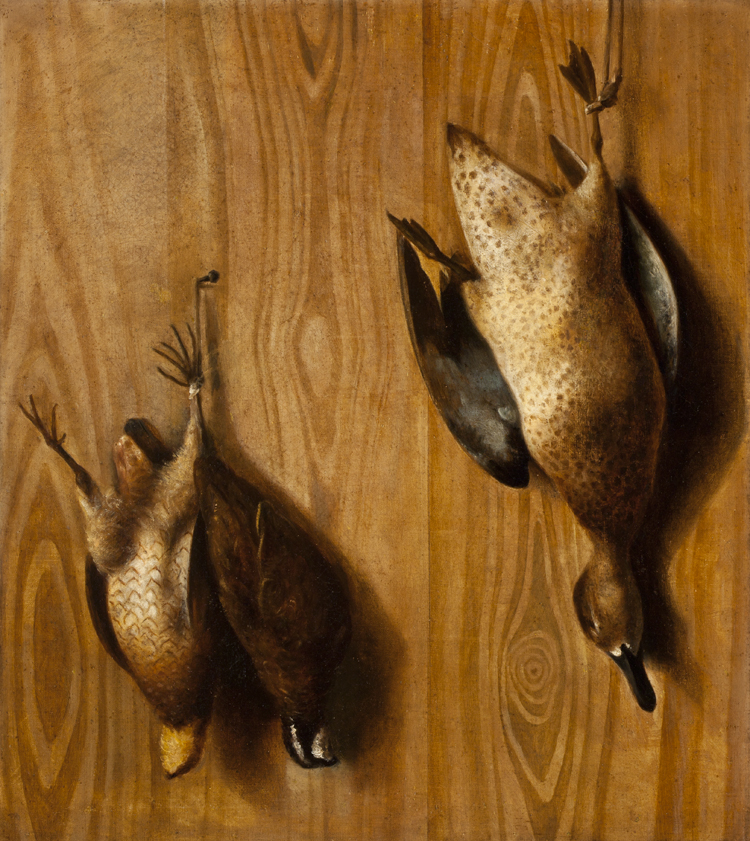
Duck and Partridges
ARTIST: Charles Fraser (1782-1860) was born in Charleston, South Carolina. He was the fourteenth and last child born to Alexander Fraser and Mary (Grimke) Fraser. At the age of sixteen he followed his family’s wishes and began the study of law. By 1804 he was working in the office of the Attorney-General of South Carolina and in 1807, he was admitted to the bar.
Though Fraser practiced law during his early adulthood, his passion was art. He demonstrated his artistic aptitude at an early age; extant sketchbooks date as early as 1796, when Fraser was only fourteen. He established lifelong friendships with artists such as Thomas Sully (1783-1872), Edward Greene Malbone (1777-1807), and Washington Allston (1779-1843). Unlike many of his contemporaries, Fraser was not an itinerant artist, though he did make five trips to the northern states where he visited the studios of other artists. In Charleston he worked to promote public art exhibitions and collections in Charleston and was a director of the South Carolina Academy of Fine Arts until its closure circa 1832.
Fraser exhibited widely during his lifetime. His work was shown in Philadelphia and New York as well as Charleston. His most important exhibit was the 1857 “Fraser Gallery” exhibit organized in his honor by a group of prominent citizens in Charleston. Over three hundred of his works were included in this exhibit. According to the catalog of the exhibition, his Still Life with Duck and Partridges (acc. 5470) was the last work he painted.
RELATED OBJECTS: It is among a large group of related objects in the MESDA collection with Fraser family histories. These include a Chippendale-style chest of drawers (acc. 2787) with a fitted upper drawer, an easy chair (acc. 2788.2), a candle stand (acc. 2788.1), the painted box created by Fraser for his niece Ann Susan Winthrop (acc. 5471), and a miniature portrait by Fraser of his niece Sophia Fraser (acc. 5509).
FRAME: In its original carved and gilt frame.
DESCRIPTION: Oil on canvas still life of a single duck and two partridges hanging by their legs and tied to a nail. Rendered in a simple, realistic style with rich earthy tones, fine details, and trompe l’oeil elements found in the wood graining.
Fraser demonstrated his artistic aptitude at an early age; extant sketchbooks date as early as 1796, when Fraser was only fourteen. He was painting by 1800, and throughout his legal career he continued to paint. He established lifelong friendships with artists such as Thomas Sully, Edward Greene Malbone, and Washington Allston. Unlike many of his contemporaries, Fraser was not an itinerant artist, though he did make five trips to the northern states, visiting other artists in route. He worked to promote public art exhibitions and collections in Charleston and was a director of the South Carolina Academy of Fine Arts until its closure circa 1832.
During his lifetime his works were displayed in such cities as Philadelphia and New York. His most important exhibit was the 1857 “Fraser Gallery,” which was organized in his honor by a group of prominent citizens in Charleston. Over three hundred of his works were loaned for this exhibit. “He painted over four hundred miniature portraits that chronicle the society of Charleston (and beyond) in the pre-Civil War nineteenth century. Although he received less support for landscape, genre, history, and still life paintings and sketches, Fraser is now recognized for his accomplishments in these areas as well.” (Robert Hicklin Appraisal Notes)
Fraser was also known in the literary circles of Charleston for his poetry and, according to his will amassed a fairly large art collection. “Fraser was esteemed and celebrated as an artist, author, and civic leader during his lifetime. A distinguished orator and author, his speeches, essays, and poetry were published in local newspapers, literary journals, and anthologies. His book, Reminiscences of Charleston (1854), is valued for its historical scope and accuracy, as well as the artist’s personal recollections of a rich and critical period in American history.” (Robert M. Hicklin Appraisal Notes)