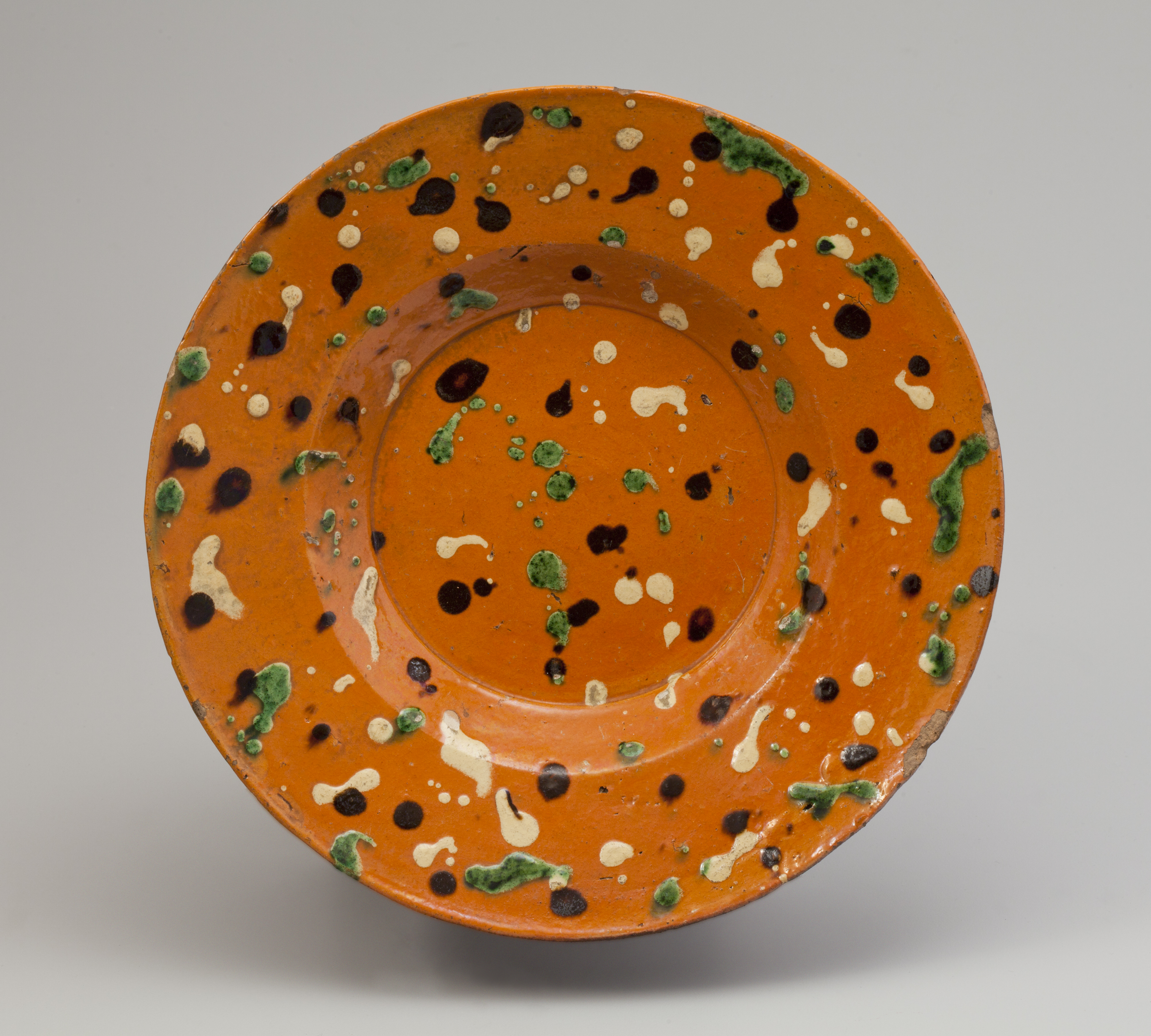
Dish
MAKER: Much of the earthenware from the St. Asaph’s tradition centered on the closely allied Albright and Loy families. Jacob Albright (1753-1825) was listed as a “potter” as early as the 1800 tax records for St. Asaph’s district, and he was also the father-in-law of potter Henry Loy (1777-1825) and the grandfather of potter Solomon Loy (1805-after 1865).
Ceramic fragments recovered at the site of Jacob Albright’s pottery document the production of earthenware with dark brown and black grounds and polychrome slip decoration. The decorative vocabulary of his pottery included marbleizing—a technique rare in southern slipware— as well as trailing in both abstract and naturalistic styles. Most of the fragments are from dishes, but bases from three mugs or tankards with polychrome banding indicate that Albright’s pottery also made decorated hollow ware. “An Inventory and an Account of Sales of the Estate of Jacob Albright Decd,” dated March 24, 1825 listed two potter’s wheels, a glaze mill, a clay mill, a grindstone, a pipe mold, a stove mold, and numerous crocks, dishes, basons, jugs, pitchers, and sugar pots. The amount of equipment would have been sufficient for a modest workforce.
Beckerdite, Luke, Johanna Brown, and Linda Carnes-McNaughton. “Slipware from the St. Asaph’s Tradition.” CERAMICS IN AMERICA. Milwaukee, WI: Chipstone Foundation, 2010.
Carnes-McNaughton, Linda. “Solomon Loy: Master Potter of the Carolina Piedmont.” CERAMICS IN AMERICA. Milwaukee, WI: Chipstone Foundation, 2010.
In Europe and America, potters working outside large metropolitan areas typically relied on kinship networks to safeguard craft knowledge; provide an affordable, trustworthy workforce; pass trade secrets from generation to generation; absorb competition and build patronage networks through intermarriage; secure raw materials and financing; and establish links to their community. As folklorist John Burrison observed, rural potters “guarded their family lines as carefully as they did their craft traditions.” As a result, family potting traditions were often as stylistically and technically monolithic as those associated with urban guilds or other governing associations. This was especially true when potters were part of a culturally homogeneous community, since makers and consumers were inextricably bound in the production of objects. At least seven members of the Loy family were potters. The American patriarch of that line was Martin Loy, who was born in Hessen, Germany, immigrated to Berks County, Pennsylvania, in 1741, and settled in Alamance County between 1755 and 1765. Generations of his family have maintained that the Loys were Huguenots, who escaped France after the revocation of the Edict of Nantes in 1688, and sought refuge in Germany. The Loys intermarried with other families who moved from Berks County to Alamance County, most notably the Albrights, who were originally of Swiss extraction. Martin’s grandson Henry married Sophia Albright, daughter of pottery owner Jacob Albright Jr. Much of the earthenware from the St. Asaph’s tradition appears to have centered on those allied families.
Solomon Loy’s career spanned the second quarter of the nineteenth century, a period when earthenware production began to wane and many potters in the piedmont region of North Carolina began shifting production to salt-glazed stoneware. He probably apprenticed with his father Henry, who worked at the pottery of the latter’s father-in-law Jacob Albright Jr. Albright’s manufactory may have been the primary training ground for many of the St. Asaph’s potters of Solomon’s generation. Archaeology at Solomon’s kiln site has documented the production of a wide range of forms, glazes, and decorative techniques including the use of dripped polychrome slips. The most dramatic objects with this type of decoration are dishes and bowls with black and cream-colored grounds and hollow ware forms with slip dripped directly onto the clay body. Most of Solomon’s trailed designs—stylized leaves, imbricated triangles, nested triangles, lunettes, and dots with jeweled edges—have antecedents in Alamance County pottery from the 1770s if not earlier. The St. Asaph’s cruciform motif, which found its last expression in his slipware, attests to the strength of artisanal and family traditions in that area of the piedmont.