Delilah (Gustin) Hunter
ARTIST: David Boudon was born (1748-1816?) was born in Geneva, Switzerland. At the age of twelve he was apprenticed to the Genevan copperplate engraver Jean-Daniel Dupre. By 1780 he was also working in metalpoint, a technique where a thin rod of metal is drawn across a surface to leave a line. There is some evidence to suggest that Boudon moved from Geneva to Italy sometime after 1786. In 1794 he emigrated to America, working first in Charleston and Savannah. His peripatetic career carried him to New York, Philadelphia, Alexandria, Virginia, Raleigh and Fayetteville, North Carolina, Baltimore, Washington, D.C., and Frederick, Maryland. His last known location is Chillicothe, Ohio.
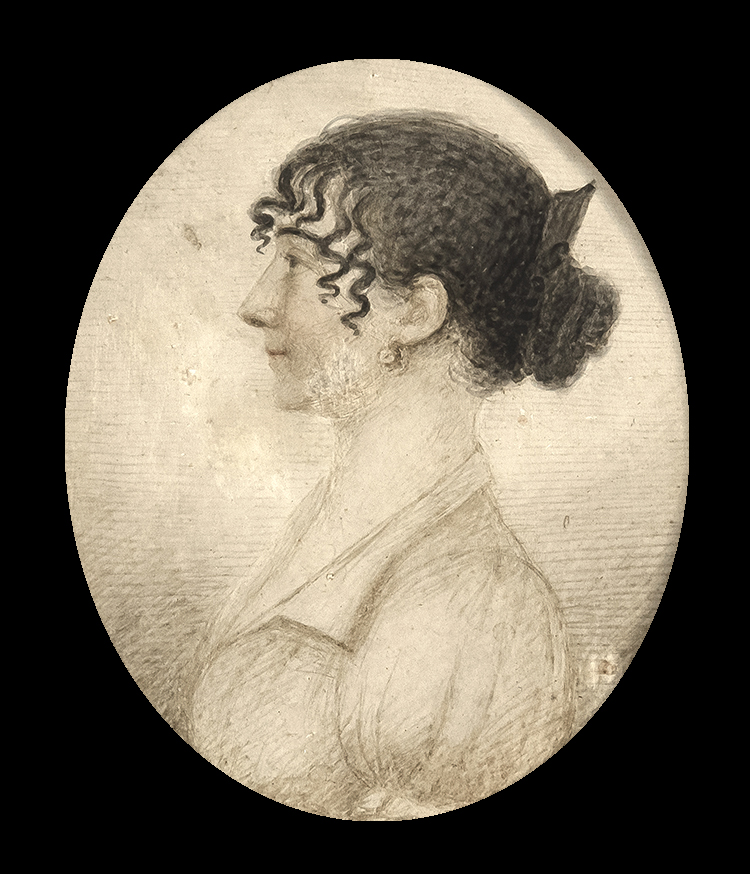
Boudon is known primarily as a miniaturist. The majority of his surviving works—50 to 60 in total—are silverpoint on vellum, although he did occasionally work in watercolor on ivory. His style, with its thin color wash over a linear image, reflects his early training as an engraver. According to his own advertisements, he considered himself more as a draftsman or “limner” rather than a painter.
RELATED OBJECTS: MESDA also owns the companion portrait of her husband by Boudon (acc. 4202.2). The MESDA collection also contains a Boudon portrait of Ann (Bolton) Moore (acc. 4145).
REFERENCES: Nancy E. Richards, “A Most Perfect Resemblance at Moderate Prices: The Miniatures of David Boudon”, Winterthur Portfolio vol. 9, (1974) 77-102.
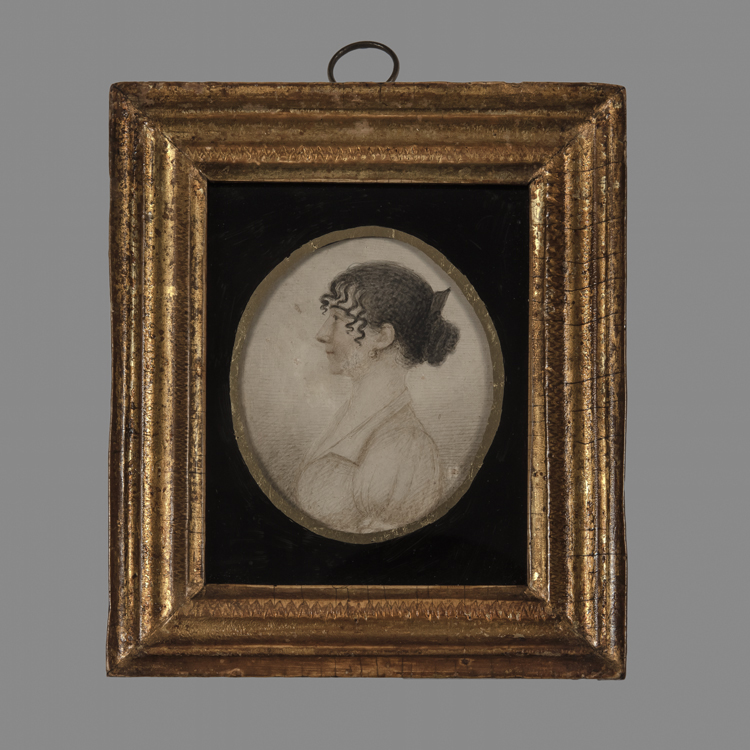
DESCRIPTION: Watercolor on card miniature of a woman in profile. She ia wearing a light colored dress and earings with her wavy dark hair combed securely in the back and bangs curled in the front. The miniature is in an oval frame
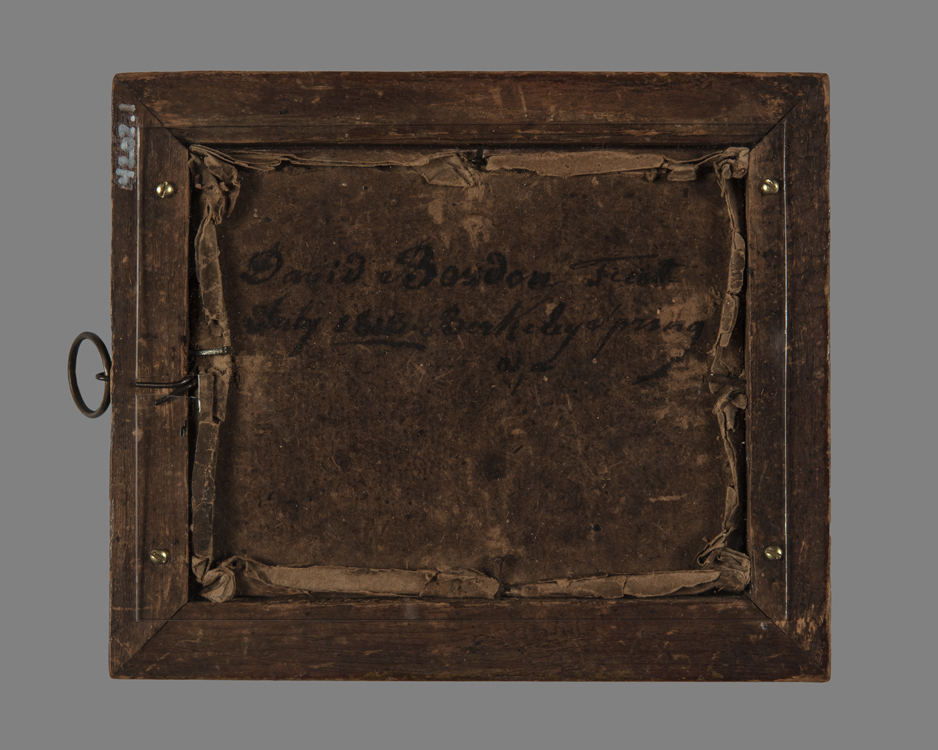
with a gold finish and the original hanger. It appears to have eglomise decoration of black with an oval opening in the center. A thin band of gold surrounds the subject (black paper also glued to inside of glass).
Boudon is known primarily as a miniaturist, working mostly in silverpoint on vellum, although some of his works are watercolor on ivory. His style, with its thin color wash over a linear image, reflects his early training as an engraver. According to his own advertisements, he considered himself more as a drafstman or “limner” rather than a painter. (See Nancy E. Richards, “A Most Perfect Resemblance at Moderate Prices: The Miniatures of David Boudon.” (Winterthur Portfolio 9, pp 77-102)