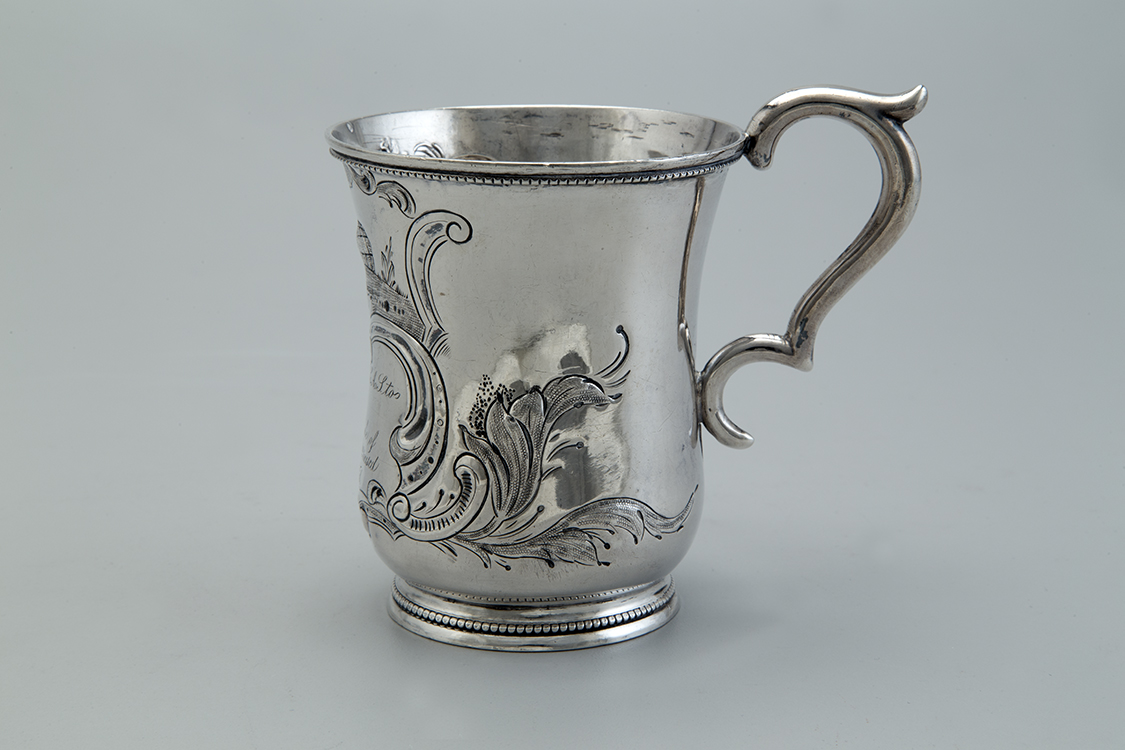
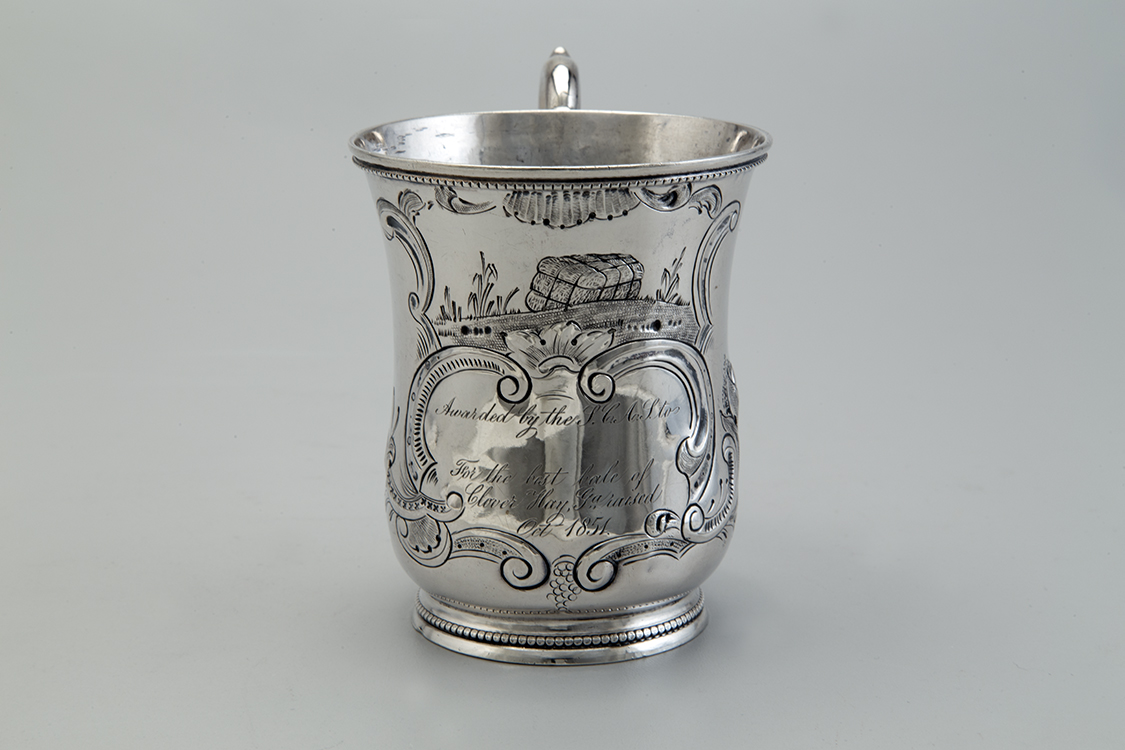
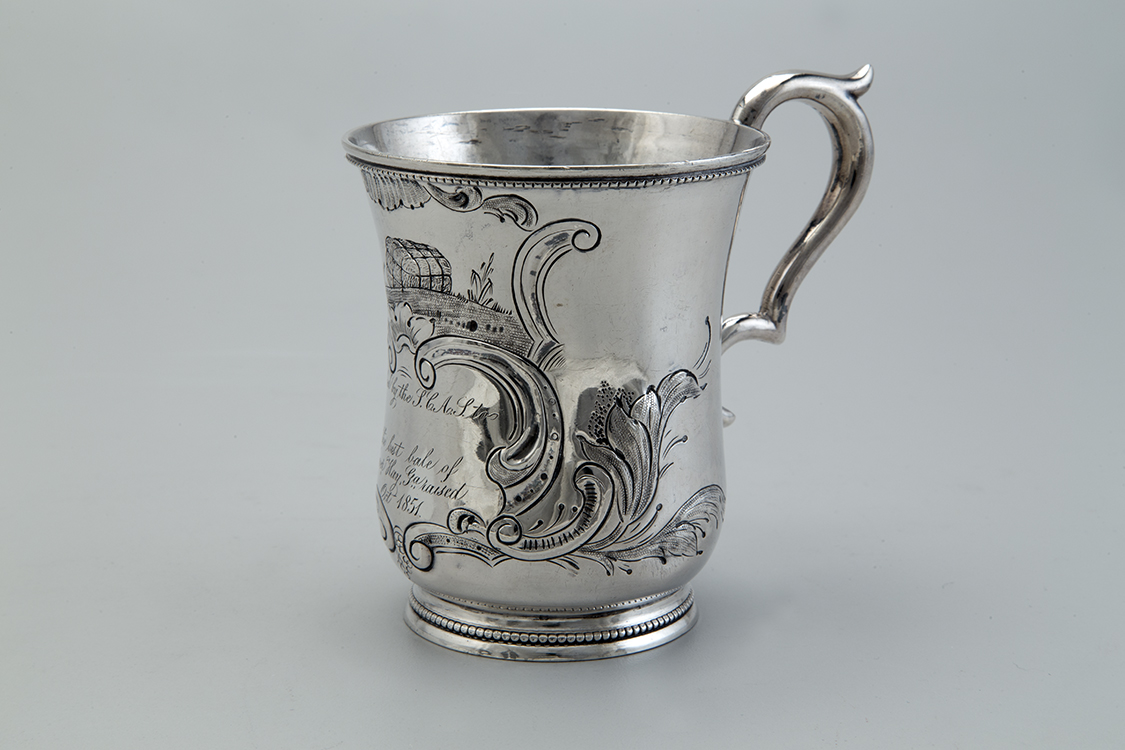
Cup
INSCRIPTION: Engraved on side of body: “Awarded by the S.C.A.S. to ___ for the best bale of clover hay, GA raised Oct 1851”. The beaker was a premium awarded at the 1851 South Central Agricultural Society fair held in Macon, Georgia.
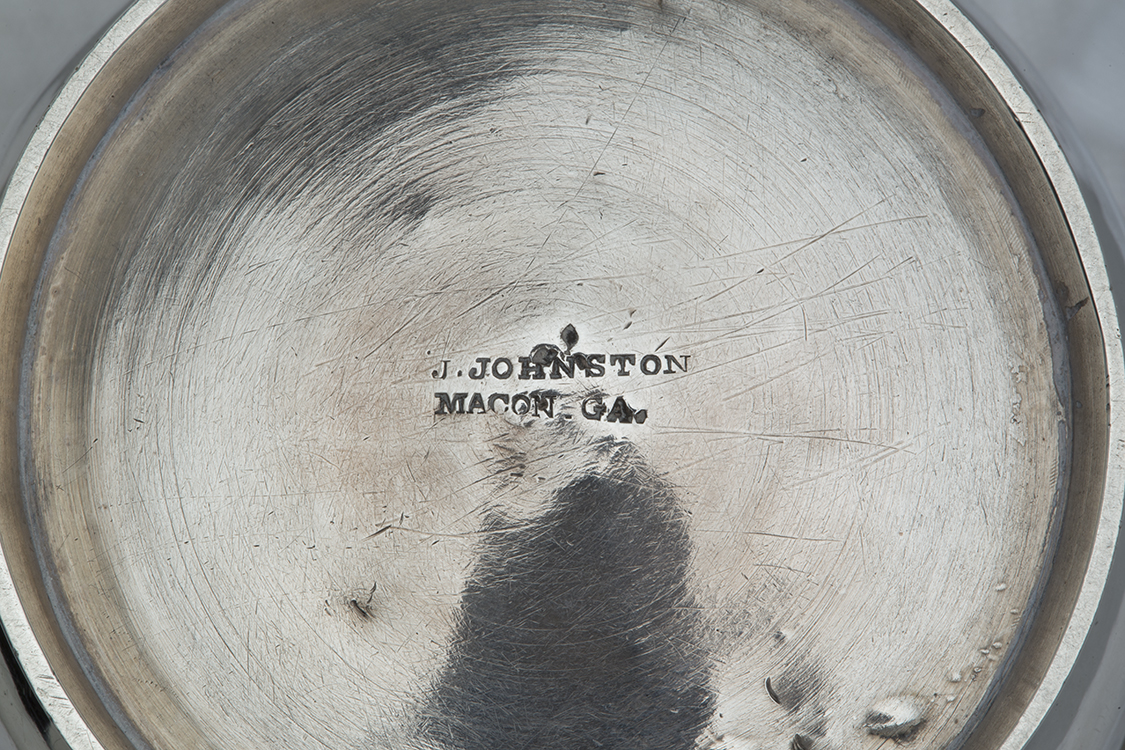
MARK: Struck with an intaglio “E.J. JOHNSTON” and “MACON. GA.” marks on underside of base.
MAKER: Edmund J. Johnston was a member of the firm W. B. Johnston & Brother from 1845 to 1849 (William Blackstone Johnston). Beginning in 1850 Edmund J. Johnston advertised independently as E. J. Johnston.
FORM: Agricultural fair prizes, or premiums, were often engraved silver pitchers, goblets, cups, and beakers rather than cash money. The silver premiums, it was hoped, would become treasured family mementos and foster continued innovation in farming communities because agricultural experimentation and adaptation were paramount to the success of American farmers of the nineteenth century. During that period, as lands in the American Deep South, Midwest and Far West were settled, the unique soils and unfamiliar climates of those new regions required experimentation with crops, farming practices, and tools in order to establish a thriving agricultural economy. Agricultural and mechanical societies fostered and encouraged such innovations. By the 1850s, considered the golden age of the movement, there were nearly 1,000 agricultural and mechanical societies in America. The Civil War severely curtailed their growth, especially in the South, and by the late nineteenth century nearly all privately operated agricultural and mechanical societies had ceased to function. By the final decades of the nineteenth century the encouragement of agricultural innovation largely became a role for governmental agencies, many of which began to sponsor state and county fairs similar to those still operated today. See Gary Albert, “Of Troughs and Trophies: A Collection of Silver Agricultural Premiums,” The Magazine ANTIQUES, May/June 2017, 110-117.