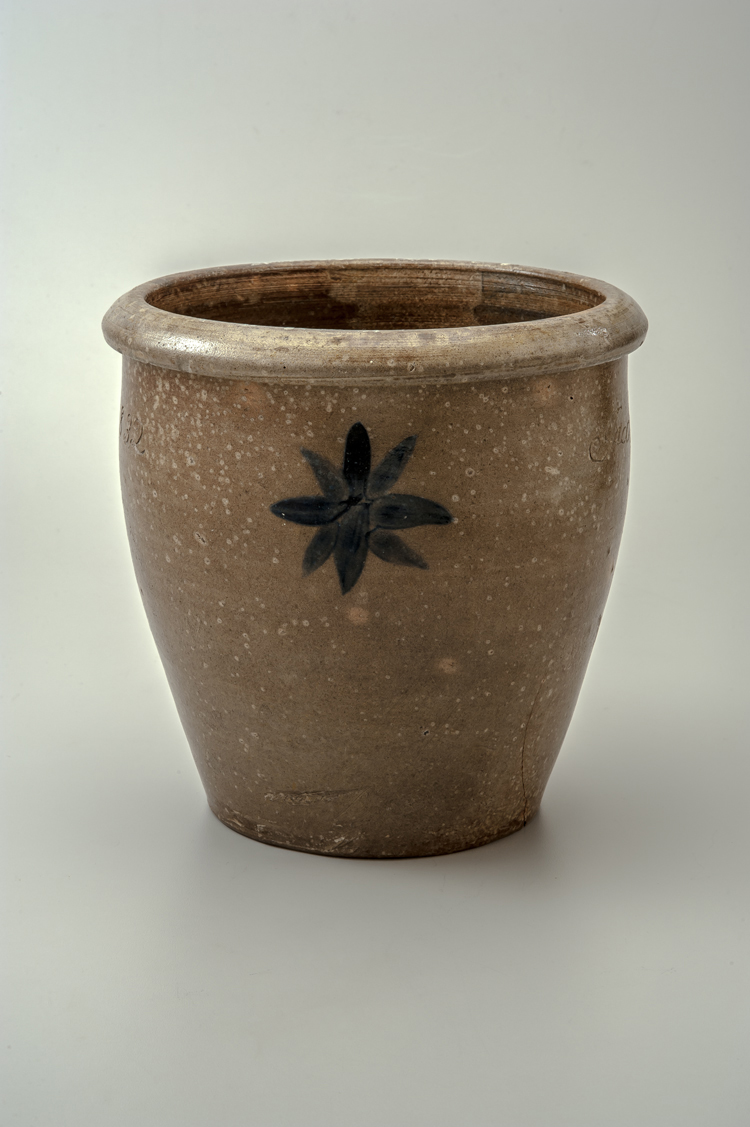
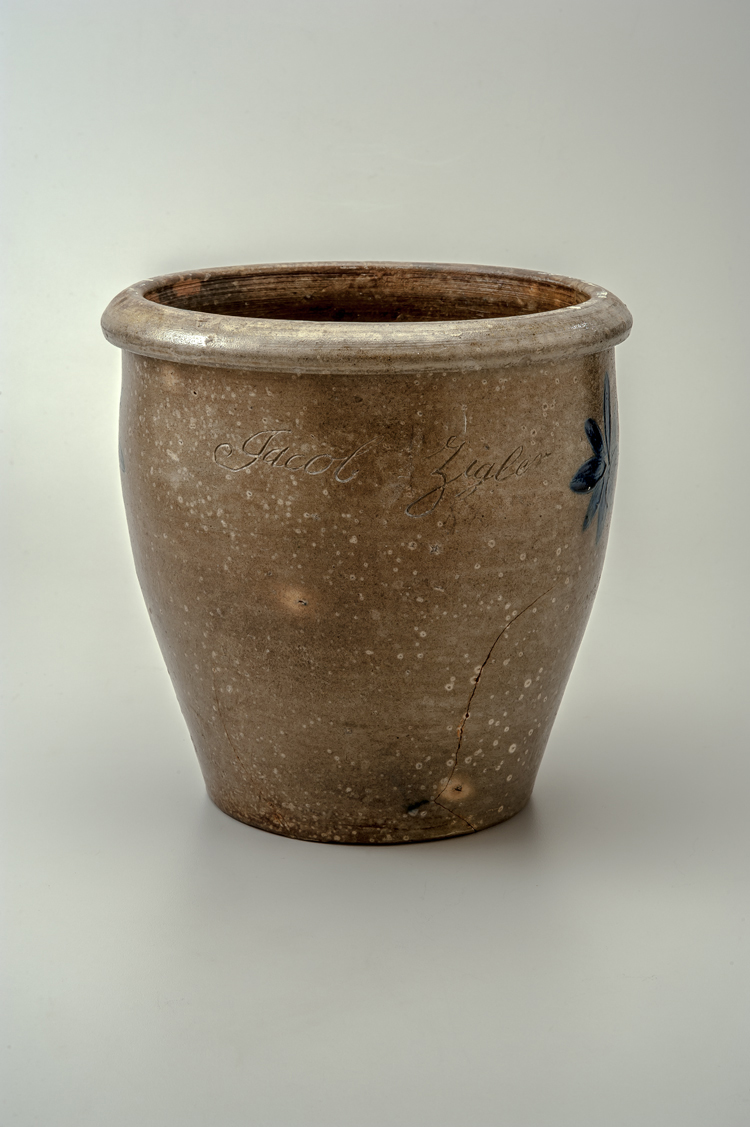
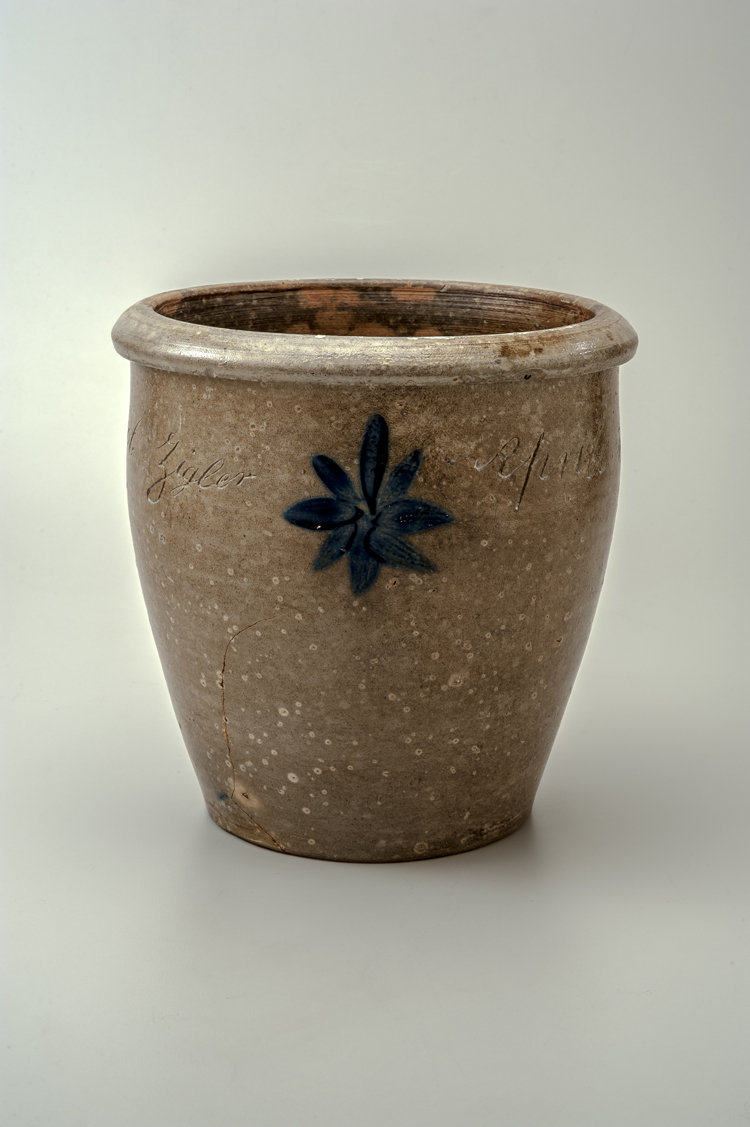
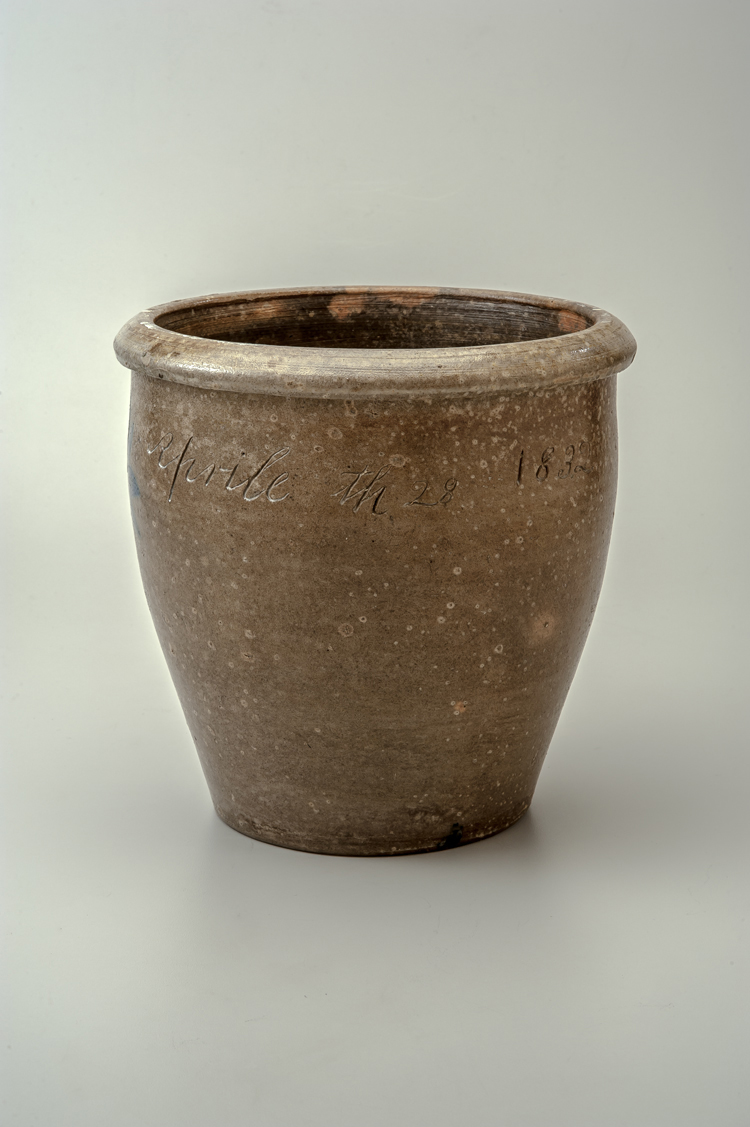
Crock
Salt glazing was a technique used by stoneware potters to create a glassy surface. When the pottery kiln reached over 2000 degrees Fahrenheit, salt was introduced to the kiln, creating a vapor. This vapor adhered to the silica in the clay, forming a glassy appearance on the pottery. Because of the high temperature at which the pottery was fired, the clay often became non-porous, or vitrified. This, combined with the salt glazing, meant that potters did not have to apply an additional glaze to the interior of the vessel. Salt-glazed pieces generally did not seep, as did earthenware pieces.
MAKER: Though signed by Jacob Zigler (1812-1896), this crock was likely made by Andrew Coffman (1795-1853). As described by Jeffrey S. Evans and Scott Hamilton in “A Great Deal of Stone & Earthen Ware,” Andrew Coffman is considered the “father of Rockingham style” pottery in the Shenandoah Valley of Virginia. Coffman moved to Rockingham County in the 1820s and was the primary potter at the pottery owned by Jacob Zigler’s father, John Zigler (1786-1856), in Timberville from 1829 to 1839, based on evidence from the surviving account books of the Zigler Pottery. John was not himself a potter, but an entrepreneur operating the pottery a few miles west of New Market, and supplementing his full-time work as a successful farmer and tanner.
Evans, Jeffrey S. and Scott Hamilton Suter, “A Great Deal of Stone & Earthen Ware.” Dayton, Virginia: Harrisonburg-Rockingham Historical Society, 2004.