
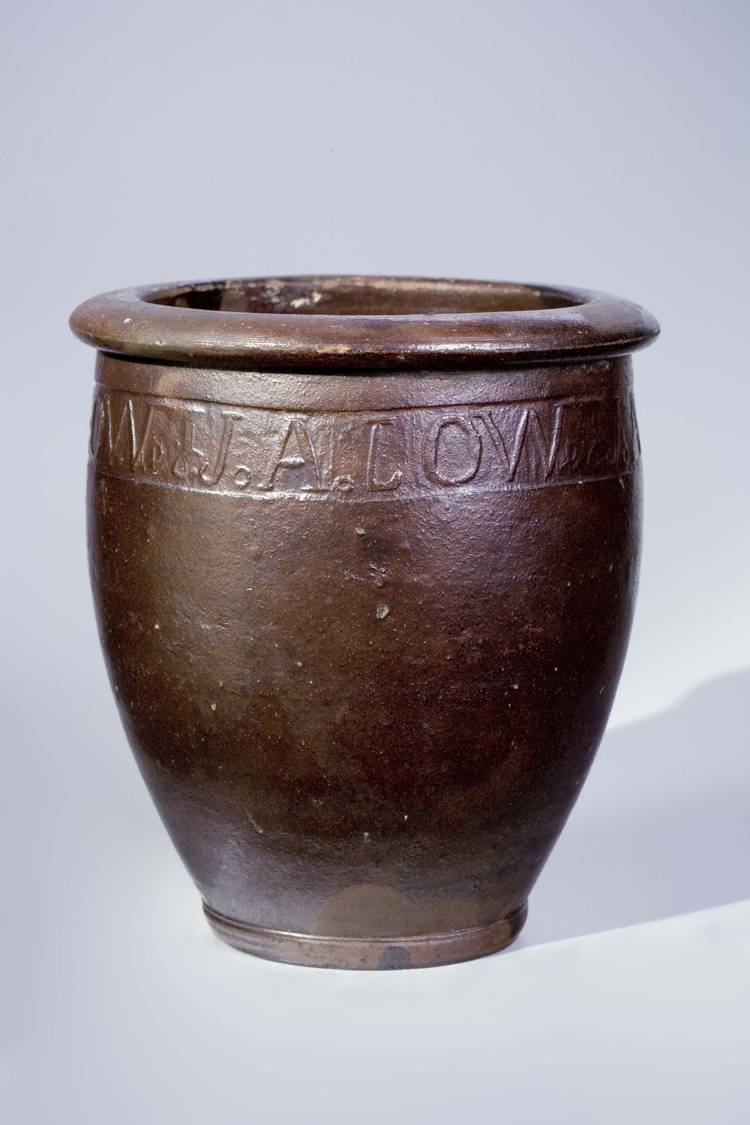
Cream Pot

Artist/Maker
Lowe, John Alexander
Place Made
Greene County Tennessee United States of America
Date Made
1850-1860
Medium
earthenware
Dimensions
HOA: 5 1/2″; DIA: (of mouth) 4 13/16″; DIA: (of base) 21/2″
Accession Number
5432
Description
Small earthenware cream pot with wide rolled rim, bulbous body, and narrow base. Dark brown in color with glaze inside and out. Recessed band around the neck approximately 3/4″ wide; having the maker’s name embossed, “J.A. LOWe” four times. The base has raised ring decoration; uneven bottom.

MAKER: John A. Lowe (1833-1902) was one of the Greene County, Tennessee potters closely associated with Christopher A. Haun (1821-1861), the celebrated Unionist potter hanged for his participation in an anti-Confederate bridge burning scheme. Unlike Haun, however, Lowe enlisted in the Confederate Army. After the war, he moved to Indiana and later Arkansas. This cream pot and a larger two-handled jar are the only two known surviving, intact works stamped by Lowe. Sherds with the “J.A. LOWe” stamp have been excavated at his pottery site.

Smith, Samuel D. and Stephen T. Rogers. Tennessee Potteries, Pots, and Potters – 1790s to 1950. Nashville: Tennessee Department oof Environment and Conservation, 2011.

Artist Biography
MAKER: J. A. Lowe (John Alexander Lowe, 1833-1902), Greene County, Tennessee. A pottery site attributed to him has been located and excavated near the Harmon Cemetery. Hundreds of sherds were recovered from the site bearing the name J. A. Lowe. The 1860 census for Greene County shows Lowe as living nearby with Blue Springs as the Post Office. Lowe enlisted in the Confederate Army two days after Christopher Alexander Haun was hung by Confederate forces on December 11, 1861. Haun was a Union sympathizer who took part in burning the Lick Creek railroad bridge during the Civil War. This important event in East Tennessee’s Civil War history was initiated with a campaign by Union loyalists to burn 9 bridges. It was led by William B. Carter and strongly supported and encouraged by President Abraham Lincoln. Several potters from the Pottertown area were among the men who conspired and succeeded in burning the bridge. However, the Union loyalists allowed the guards to go free based upon their solemn promises to not reveal their identities. Union troops did not materialize as promised, and the Confederates were able to pursue and capture some of the perpetrators. The Confederate guards, who were allowed to live, were the very ones who served as witnesses to implicate the five men who were hung, four of them potters. Among those sentenced to hang was the potter Christopher Alexander Haun. His pots clearly speak for his having been a master potter. In a letter which Haun wrote to his wife in his last hours he said “have Bohanan, Hinshaw or Low to finish off that ware and do the best you can with it for your support.” It is highly probable that Haun was referring to J. A . Lowe in this letter. This decorated J. A. Lowe jar has very similar characteristics to known C. A. Haun jars. The general form of the jar, the appearance of the extruded handles with the decoration at the handle attachments and the stamp design around the shoulder of the jar with the name of the potter are all similar to marked C. A. Haun jars. J. A. Lowe was almost 29 years of age when Haun was hung. Whether Lowe apprenticed under C. A. Haun is not known at this time. Lowe’s Confederate Certificate of Disability for Discharge dated February 21, 1862 (Courtesy of Donahue Bible) records his occupation as potter. It is also not known if Lowe ever potted again after being discharged from the military. He and his family were living in Indiana by 1865. They had moved to Arkansas by 1880. He died in Arkansas.

(Information provided by Case Auctions and Antiques 5719 Woodburn Drive
Knoxville, TN United States 37919; http://cgi.liveauctions.ebay.com/64-Rare-marked-East-Tennessee-redware-jar-J-A-Lowe_W0QQcmdZViewItemQQcategoryZ28221QQihZ011QQitemZ320294749451
Credit Line
MESDA Purchase Fund