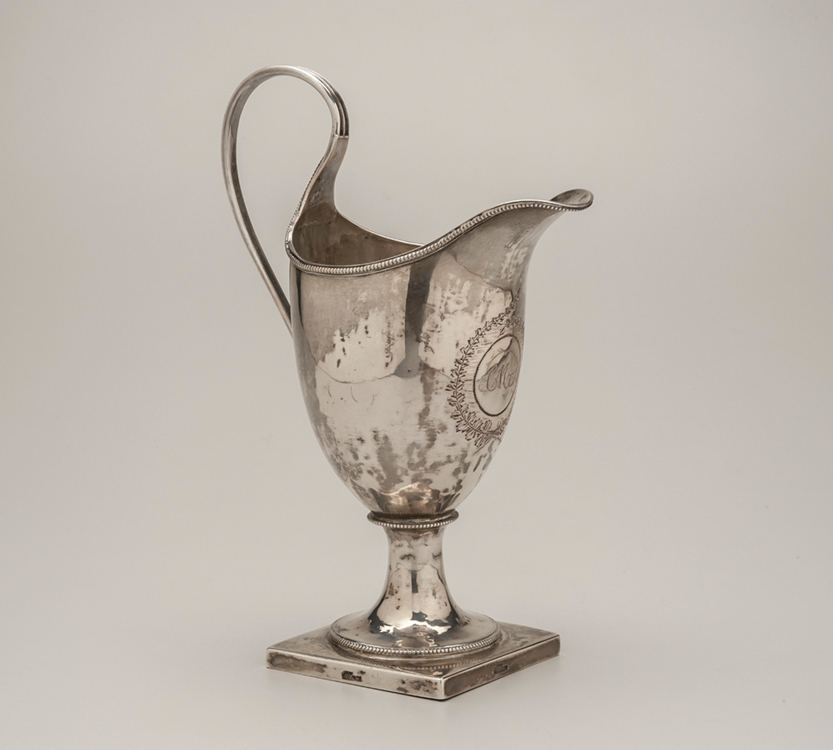
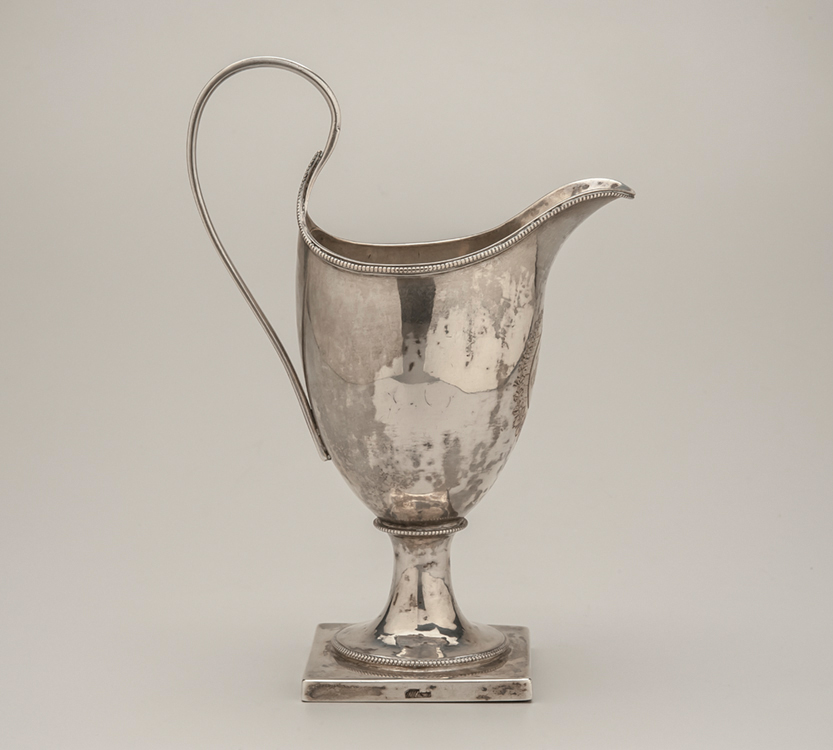
Cream Pitcher
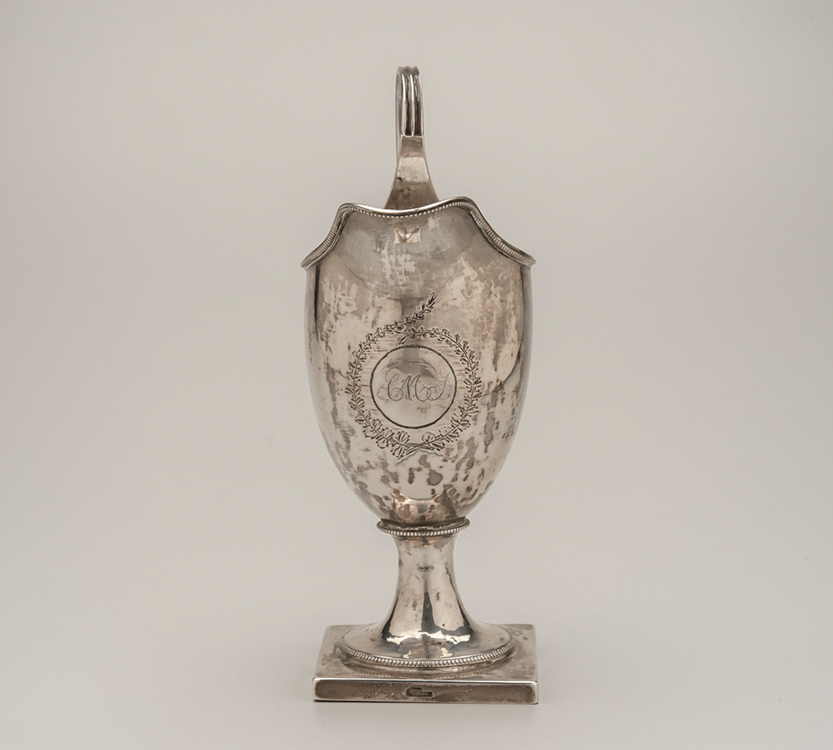
INSCRIPTION: Engraved on the side of the body below the spout are the script initials “CMT” within a large bright-cut bowknot surrounding a circle. The area between the bowknot and the circle has unusual horizontal lines that appear to be a shading attempt, perhaps to add the illusion of depth.
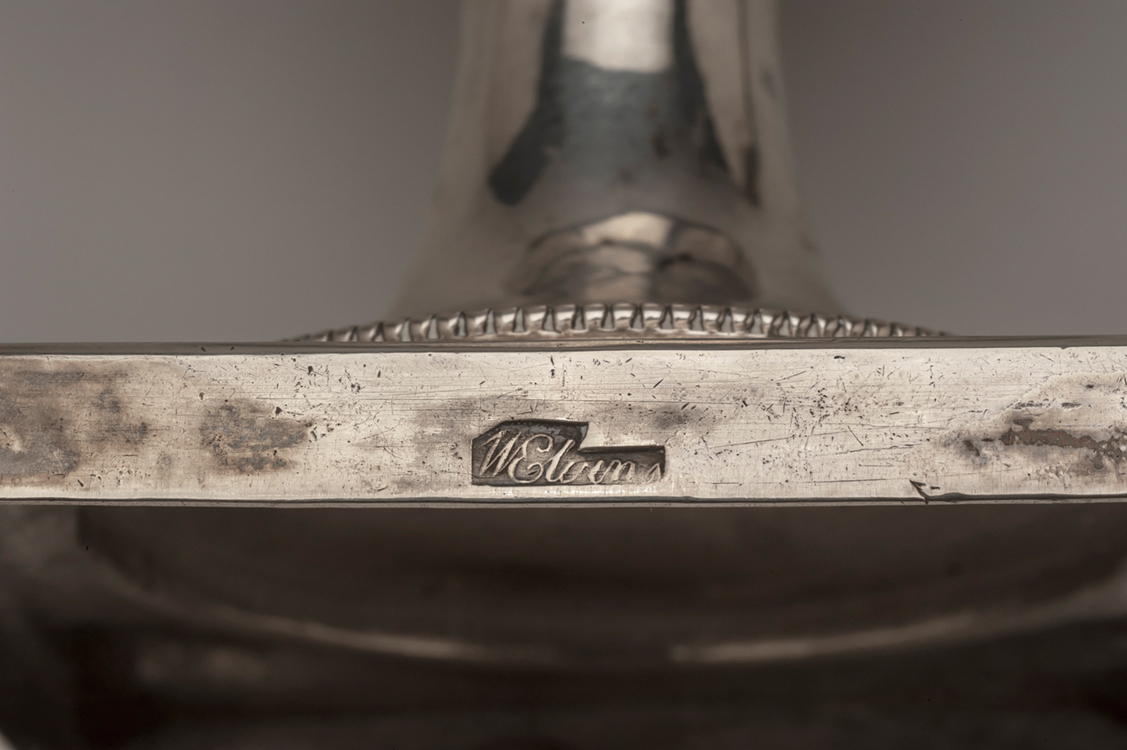
MARK: Struck on face of square plinth base with an intaglio, script, “WElvins” mark in a conforming reserve.
MAKER: Fells Point, the older part of Baltimore, Maryland, was the shop location of clockmaker and silversmith William Elvins. Listed in the Baltimore directories as a watch- and clockmaker from 1796 until 1808, in 1799 Elvins announced his removal from 4 Fell Street and advertised work in silver as well. From 1802 until 1808 Elvins’s shop is listed in the directories at 12 Fell Street. Jacob Hall Pleasants and Howard Sill, “Maryland Silversmiths, 1715-1830” (Baltimore, MD: Lord Baltimore Press, 1930) and Jennifer Faulds Goldsborough, “Silver in Maryland” (Baltimore, MD: Maryland Historical Society, 1983).
FORM: Silver pitchers in Colonial America were most often small cream pitchers in the rococo fashion that were used as part of the tea ceremony to serve milk and for most of the eighteenth century the accouterments of the tea ceremony were acquired separately and did not necessarily match in style and shape. By the 1790s, all elements of a tea service (coffeepot, teapot, sugar bowl, waste bowl, and cream pitcher) were made somewhat uniformly in style, with the smaller pieces following the form of the coffee and teapots.