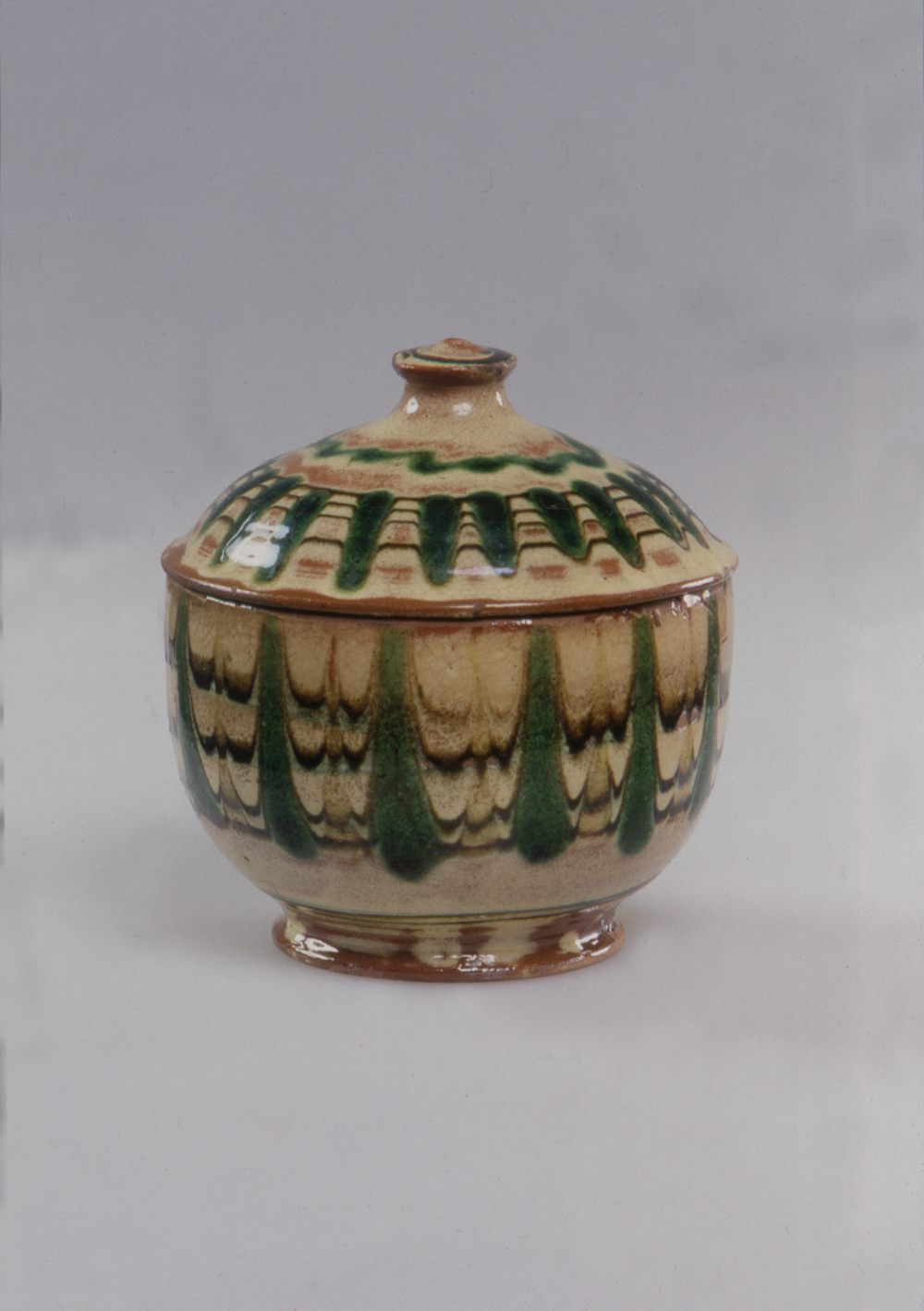
Covered Bowl
Earthenware is a porous material and must have an applied glaze in order to hold liquids. The interior of the lid is unglazed, as well as the rim of the bowl.
MAKER: Henry Adam’s first advertisement for his pottery business in Hagerstown, Maryland, was in 1805. There are no known marked or signed examples of his work. Mary Adam, daughter of potter Jonas Knode, and wife of potter Henry Adam, inherited the pottery shop of her husband upon his death in 1819. Shards similar to the Adam dish in the MESDA collection (4361) and this sugar bowl have been excavated in New Market, Virginia, at the site of the shop of Adam’s brothers, Christian and Jacob. Shards resembling Adam’s pottery have also been excavated in Hagerstown at the Hager House. MESDA has a plate (acc. #4361) also made by Henry Adam and a storage jar (acc. #4075) made by Mary Knode Adam, Henry Adam’s wife.
Comstock, H. E. THE POTTERY OF THE SHENANDOAH VALLEY REGION. Winston-Salem, NC: MESDA, 1994.
Although it is not known to whom he may have been apprenticed, it is possible that he worked at one time for Jonas Knode, for he married Mary Knode in 1807. In 1803, Adam bought lot 5 of Daniel Heister’s addition to Hagerstown. In 1805, Adam bought lot 133 from Henry Strauss. An ad ran in the Maryland and Hagerstown Advertiser on August 25th of that year announcing that Henry Adam was carrying on business ” at the former shop occupied by Mr. Henry Strause [sic], Burrmaker… on the Main Street in Hagerstown leading from the court-house to Stoll’s old mill.” The products Adam had on hand included: “Milk Crocks, Dishes, Pitchers, Jugs, Mugs, Bowls, Preserve Jars of every kind.”
Adam apparently interacted with Peter Bell as Bell sold Adam white clay he had bought from Chambersburg. In 1810, According to the Peter Bell account book, Bell sold Adam five and one half dozen flat crocks. In 1813, Adam was one of several potters including John Bell to advertize set prices for their earthenware.
Adam died in 1819 leaving his wife and several young children. His estate inventory did list “a large quantity of Crockery Ware” but did not list pottery tools.
*In his book, THE POTTERY OF THE SHENANDOAH…, Gene Comstock stated that Adam was a native of Hagerstown. More recent research suggests that this was not the case and that he may arrived by ship from [Gene to call back] in 1797. The ship’s register lists a Henry Adam as a potter. Gene points out that the possibility exists that the Henry Adam listed as a potter on the ship was father to a son by the same name. [NOTE: Would a 16 year old be listed as having an occupation on a ship register?]
(Summarized from conversation with Gene Comstock on July 23, 1997 and section on Henry Adam in H.E. Comstock, THE POTTERY OF THE SHENANDOAH VEALLEY, 1994: 356-357.)