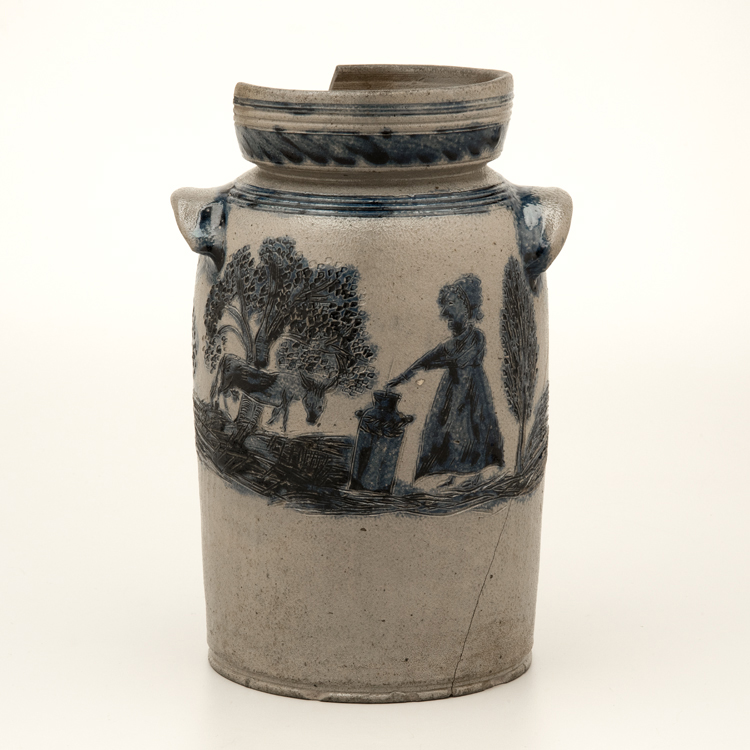
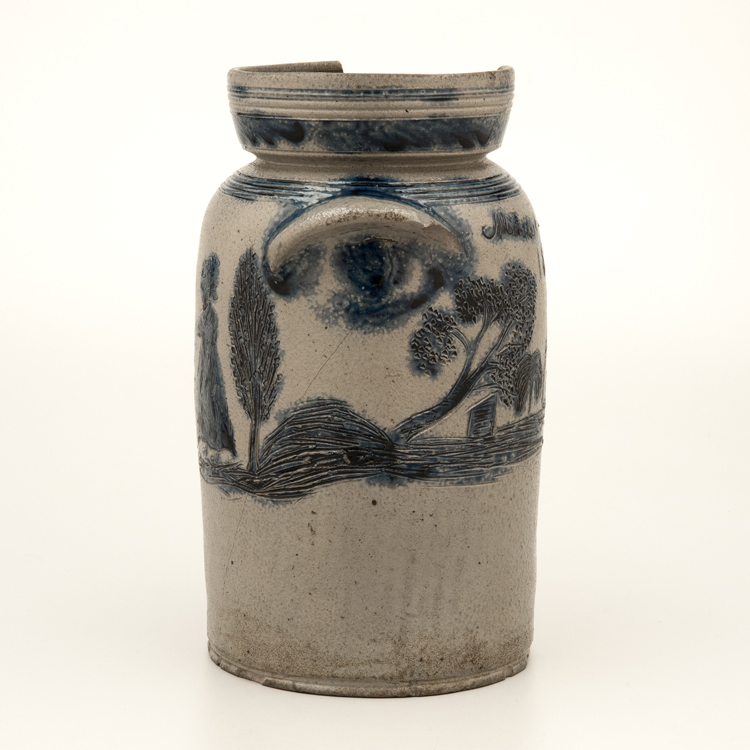
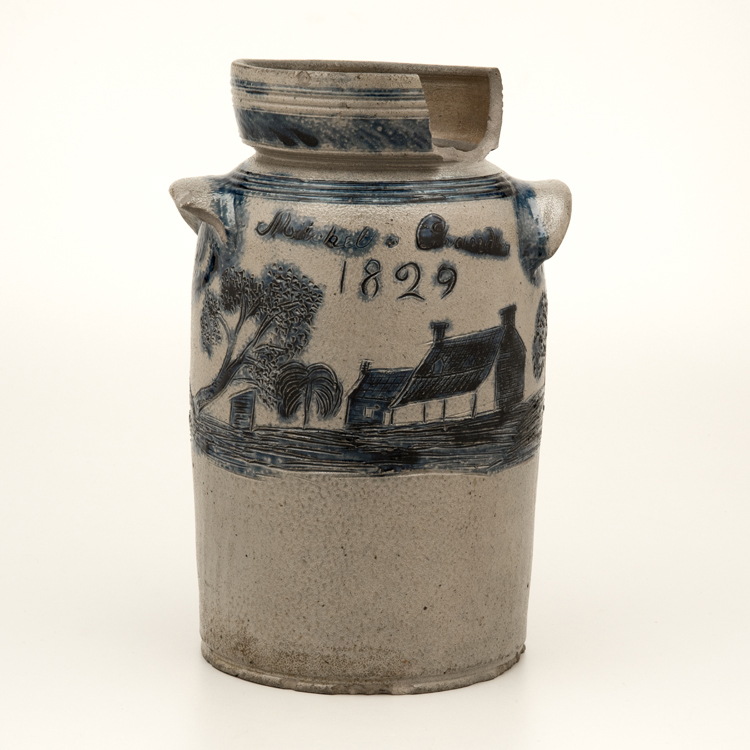
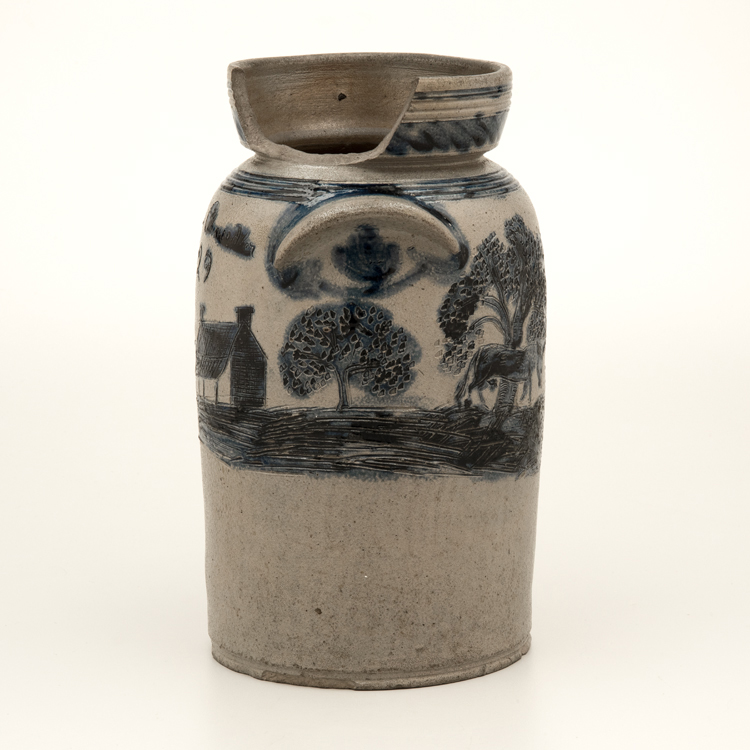
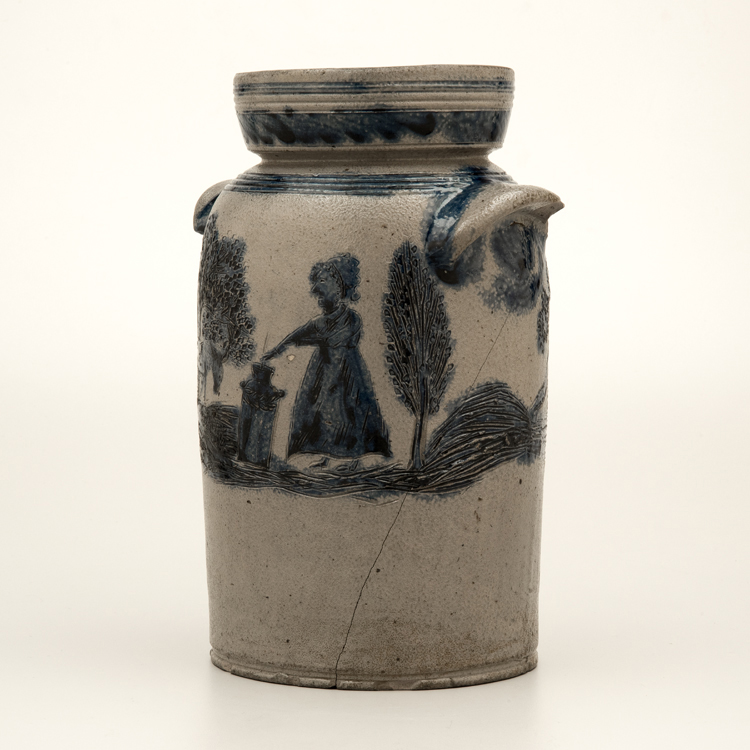
Churn
Salt glazing was a technique used by stoneware potters to create a glassy surface. When the pottery kiln reached over 2000 degrees Fahrenheit, salt was introduced into the kiln, creating a vapor. This vapor adhered to the silica in the clay, forming a glassy appearance on the pottery. Because of the high temperature at which the pottery was fired, the clay often became non-porous, or vitrified. This, combined with the salt glazing, meant that potters did not have to apply a glaze to the interior of the vessel. It could hold liquids and not seep, unlike earthenware storage vessels.
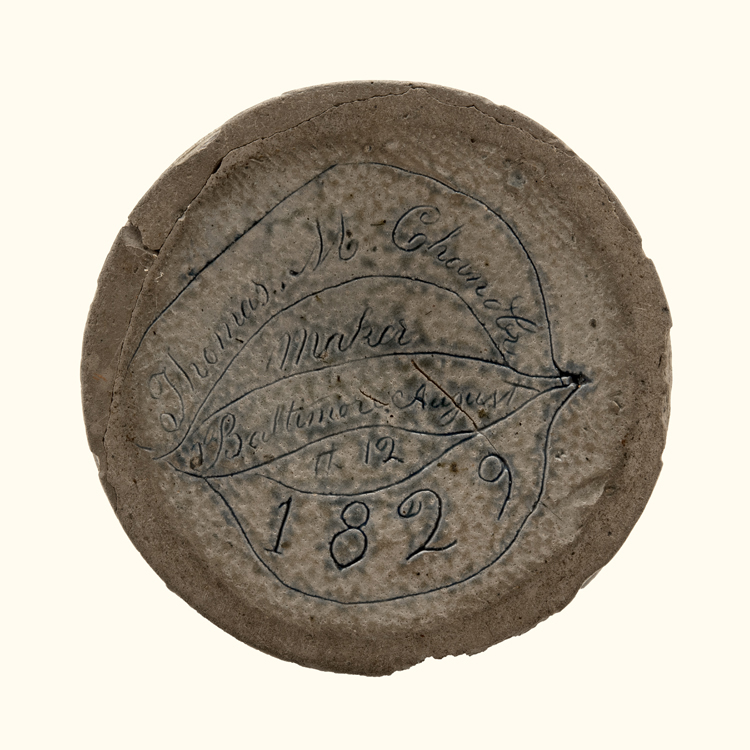
MAKER: Thomas Mitchel Chandler, Jr. (1810-1854) was born in Accomack County, Virginia. His family moved to Baltimore in 1817 and there Thomas developed into an extraordinary potter. Thomas’s future was partly determined by his father’s move to Baltimore. As a chairmaker, Chandler’s father bought property in a district with many other craftspeople, including five major potters: Henry Remmey, Sr., Henry Myers, David Parr, Elisha Parr, and William Amoss. Henry Myers probably trained Thomas Chandler; Chandler’s first dated and signed piece resembles pieces made in Henry Myers’s shop in the 1820s.
Thomas Chandler left Baltimore in 1829 and between 1829 and 1832 may have traveled as an itinerant potter. In 1832 he was in Albany, New York, where he enlisted in the U.S. Army. The Army sent Chandler south to Augusta, Georgia, and between 1832 and 1836 he served in various capacities and likely worked with several potters in Georgia. Scholar Philip Wingard estimates that Chandler was in Edgefield, South Carolina, working by 1836, since several of his pieces with decorative slip work and dated 1836 have survived in the region. He worked in various pottery factories and with various partners in the region until he had his own shop by 1850. In 1852, though, he and his family moved to North Carolina where he died in 1854.
Wingard, Phillip. “From Baltimore to the South Carolina Backcountry: Thomas Chandler’s Influence on 19th-Century Stoneware.” CERAMICS IN AMERICA, 2013, 38-76.