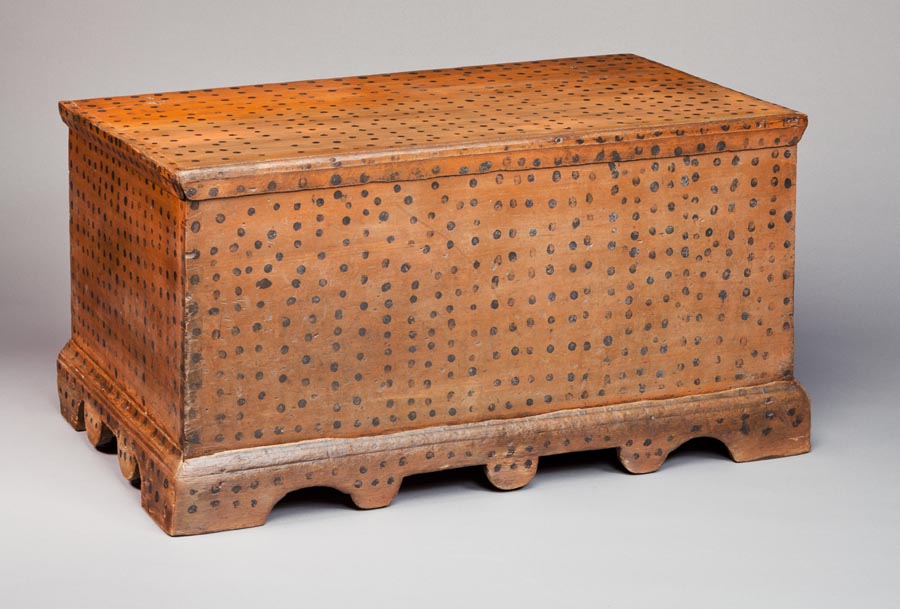
Blanket Chest
STYLE: Both the basic construction and unsophisticated decoration of this chest strongly suggest it was a completely homemade product, and not one of an established cabinetmaking shop. As with many “neat pieces,” that is part of its charm.
MAKER: See HISTORY
The chest’s history is most closely associated with Henry and Nancy’s youngest daughter, Elizabeth Adams Johnson (1856-1940), who was given the chest by her mother and father. Elizabeth’s memories include the chest’s “hiding” her family’s valuables during the Civil War—that most quintessential and ubiquitous of southern memories. According to Elizabeth, “During the Civil War when it was rumored the Yankees were coming, whatever was considered of most value would be put in the ‘chist’ and hidden in the leaves in the woods.” Lending credence to then 10-year-old Elizabeth’s memory is the harrowing experience of Wilkes County residents during Stoneman’s Raid in the spring of 1865. Union cavalry under General George Stoneman plundered through Piedmont North Carolina as part of the North’s effort to demoralize the South. According to historian Chris J. Hartley, the Wilkesboro area “bore more than its fair share of pain.” In fact, one local historian of the period described the time as one of “robbing and plundering everything in sight leaving [in] their trail a howling wilderness.” That the Adams family would use the spotted chest to protect their most valuable belongings from marauding troops is entirely believable.
In 1880 Elizabeth married the young widower, Sidney Lewis Johnson. Her granddaughter Butrice Johnson Luffman remembers “Grandma Betty” saying that she packed “her clothes and linen in a chest, which she called a ‘chist,’ that was painted brown with black coin dots,” and traveled the short distance from her family home to the small frame home of her new husband. There it stored personal possessions, was sat on, and probably played in while Sidney and Elizabeth raised ten children. One special object stored in the chest still survives: Elizabeth’s white cotton wedding dress.
Even as it aged and faded, the “chist” remained a prized family heirloom and was passed down to Elizabeth’s granddaughter, Butrice Johnson Luffman. Perhaps inspired by the love her family had for the little spotted chest, in 1965 Mrs. Luffman became one of the first “hostesses,” or guides, at the newly opened southern decorative arts museum in Winston Salem known as MESDA. When Mrs. Luffman died, her three daughters most generously donated the chest to MESDA in memory of their mother, who recognized the importance of the colorful little chest.
Today the Johnson chest is a prized part of the MESDA Collection because it tells the story of a simple object imbued with multiple layers of meaning for the women in one backcountry North Carolina family. It speaks volumes for all of the early hard working, average females whose objects and stories have not survived.