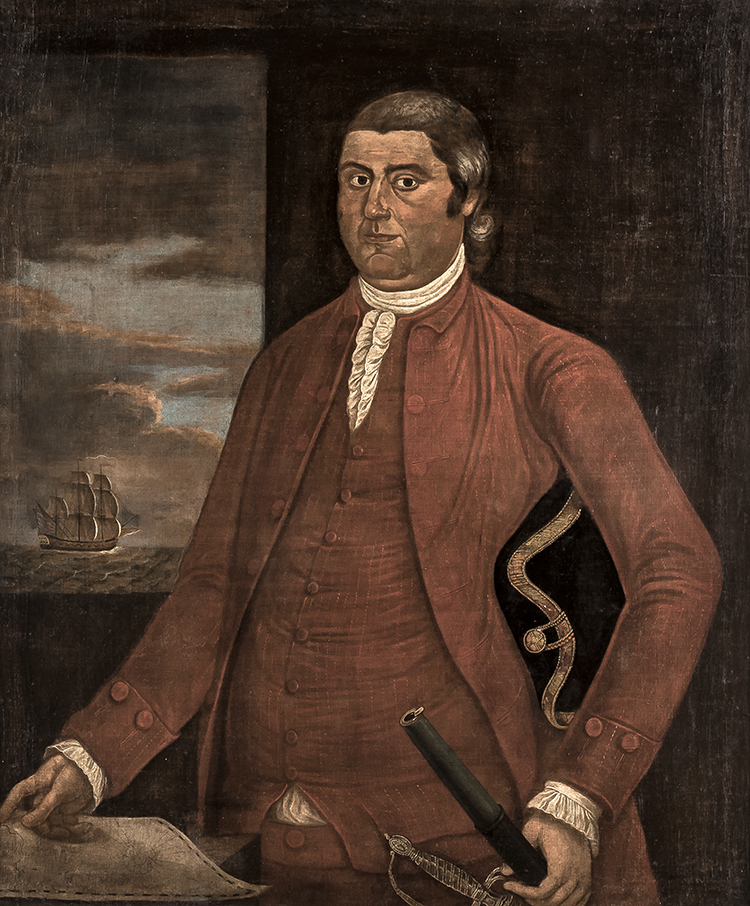
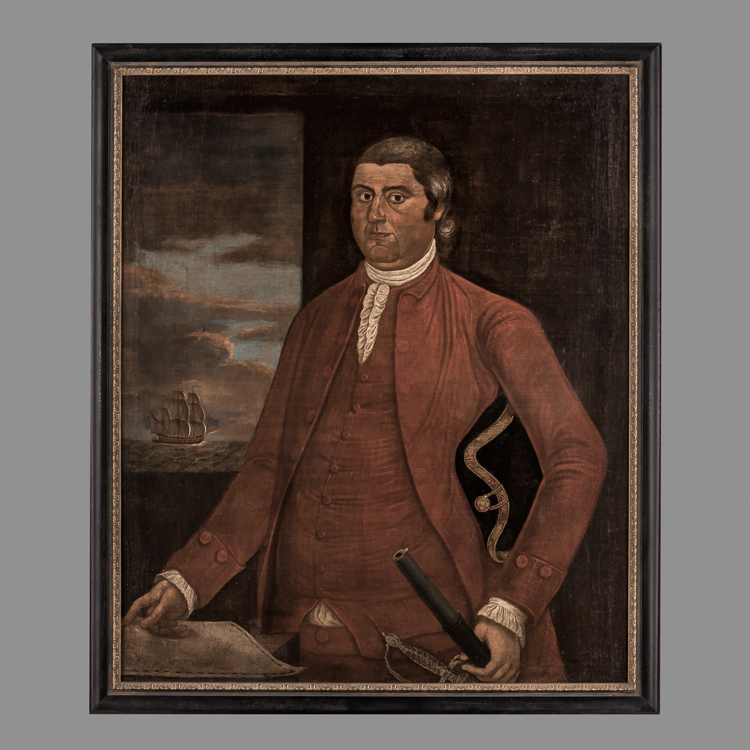
Captain Nicholas Brown Seabrook
Framed: HOA: 42 1/2″; WOA: 36″
Seabrook continued, however, to participate in maritime affairs. In 1776, he offered for sale “a very fine Sloop fit for the West India Trade.” The following year, he became captain of the Liberty, a 60-ton, 8-gun Virginia sloop that he co-owned with merchants John H. Norton and Samuel Beale of Williamsburg. The Liberty engaged in trans-Atlantic trade, sailing from Virginia and North Carolina to the European ports of America’s Revolutionary War ally, France. In 1778, Seabrook retained partial ownership but relinquished command of the ship which was later seized by British forces off the Virginia coast at Cape Henry. In 1782, Seabrook became captain of an 8-gun, 25-person crew privateer called the Goldfinder.
In a February 15, 1782 letter to his brother Thomas in New Jersey, Nicholas Brown Seabrook perfectly described his economic rise from sea captain to merchant to planter and land speculator. “Some time ago,” he noted, “I wrote you that I had Suffered by the depresiating of the money, & had Quit Trade & Bought Lands & Negroes & Turned Farmer. Now by the Mooving of the Seat of Government to Richmond, where I have five half acre Lotts of Ground & my Plantation of 727 acres of Land leying 11 miles from the Town, it has more than doubled its Value & made ample amens for the Losses of Depreseation. My Istate is worth about Eight Thousand Pounds Sterling, & is Very Capable of Impro[vement] as I have Ground enough in Town to build 12 more houses, & I am going to Sea again to Import Materials & Fix my Son in Europe to finish his Education.” Seabrook died in Richmond on June 28, 1790, bequeathing his Richmond properties and Hanover County plantation to his wife and children. His tomb survives beneath a later addition to St. John’s Church, while those of his grandchildren, Nicholas Brown Seabrook Rind and Maria Dutcher (Rind) Trueheart, are immediately adjacent to the church.
ARTIST: William Hodgson (1748-1806) was a London-born artist who emigrated to Virginia during the Revolutionary War. Previously called “The Payne Limner”—based on ten surviving portraits of the Payne family—he worked in Richmond and the surrounding counties of Henrico, Hanover, and Goochland in the late 18th and early 19th centuries. Approximately 18 of his works are now known. None of these works bears a signature or date, and the attributions are based on the strong stylistic similarities among the various portraits. The discovery of a portrait of Elizabeth Christian Humber (d.1835) (MESDA acc. 5984.1), Hodgson’s daughter’s mother-in-law cemented the attribution.
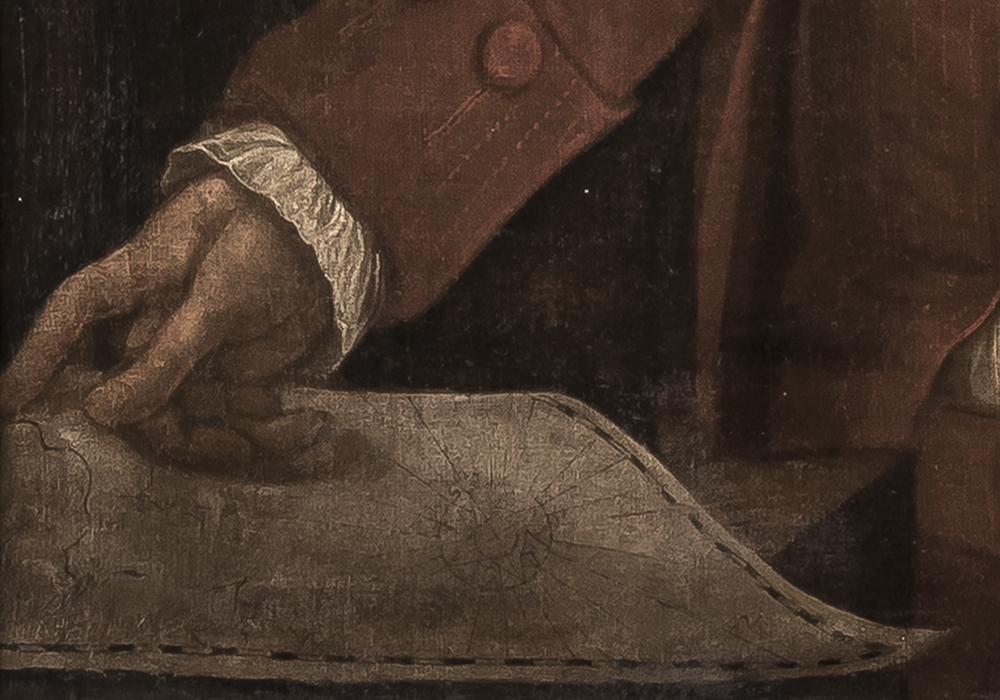
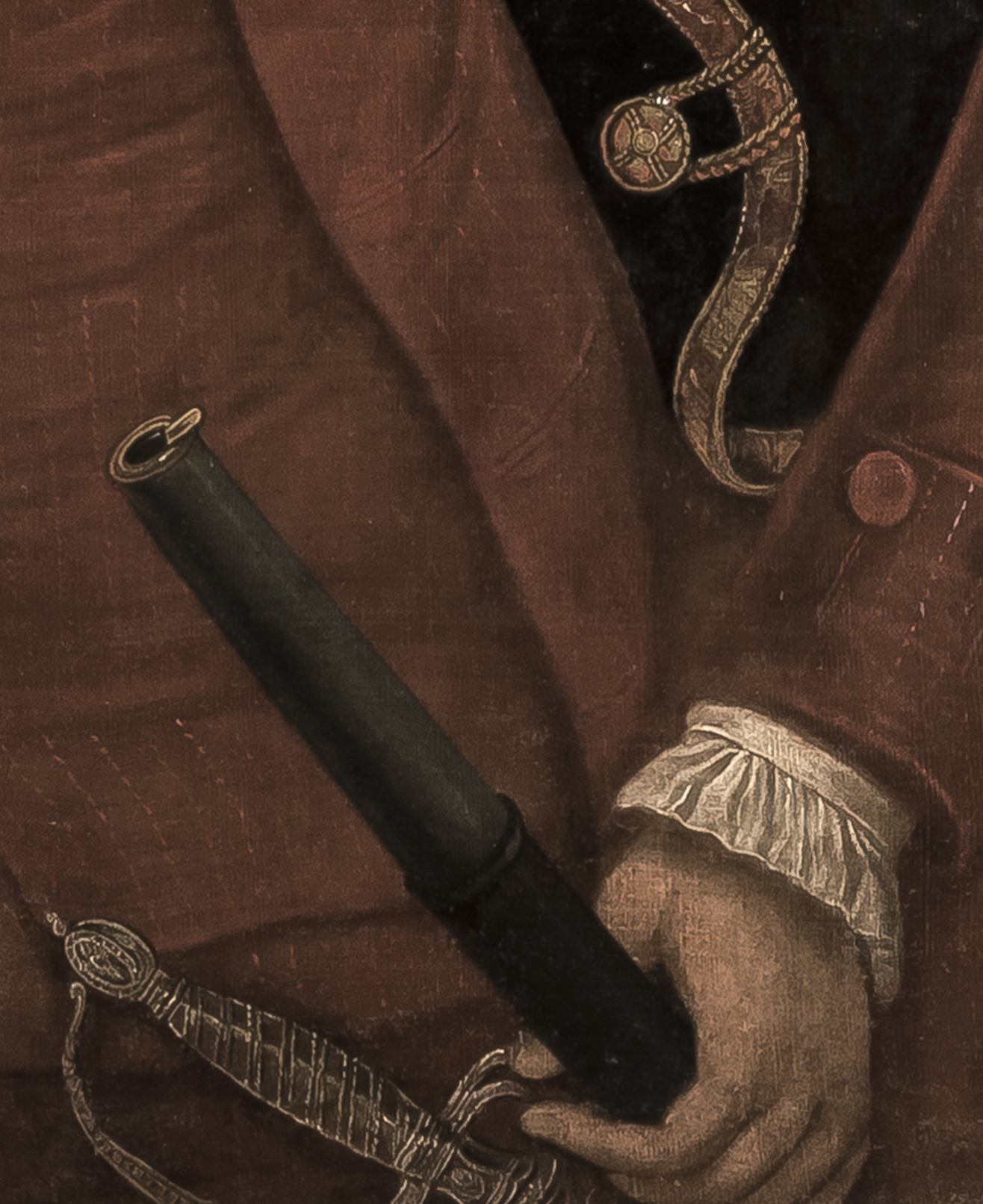
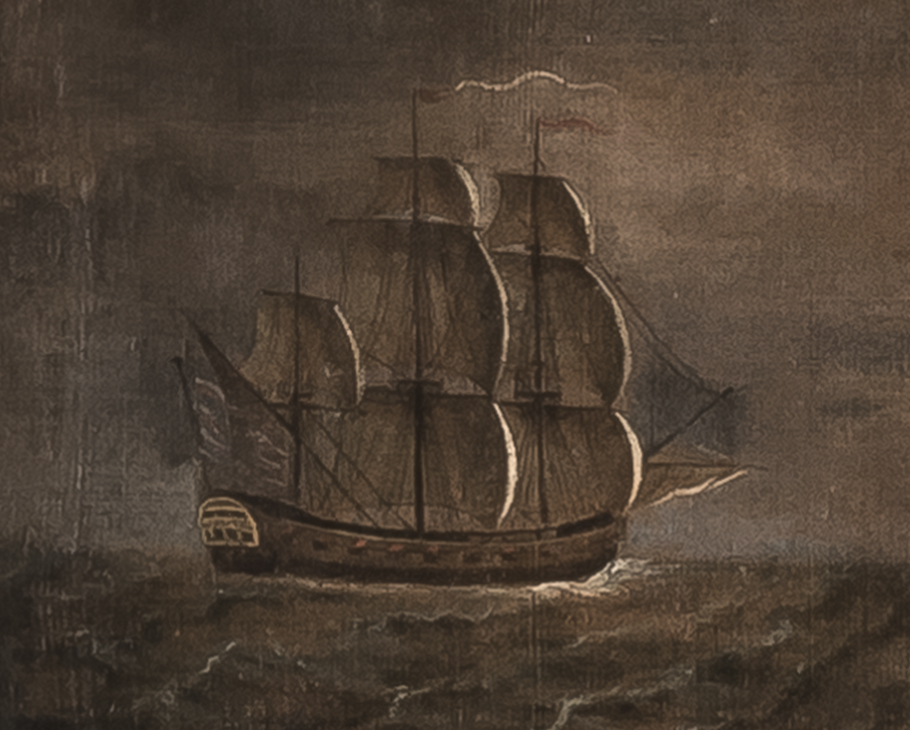
DESCRIPTION: An oil on canvas three-quarter length portrait of a sea captain wearing a red suit, white shirt with ruffled cravat and cuffs. He is holding a telescope in his left hand with a tri-corn hat tucked under his left elbow, and a gold-hilted sword hanging prominently from his waist. With his right hand he points to a chart, possibly of the James River, with a masted ship sailing in the background. The ship’s flag consists of thirteen alternating red, white, and blue stripes, a typical ensign for American navy vessels and privateers during the Revolutionary War period.