Boys of the Powell Family
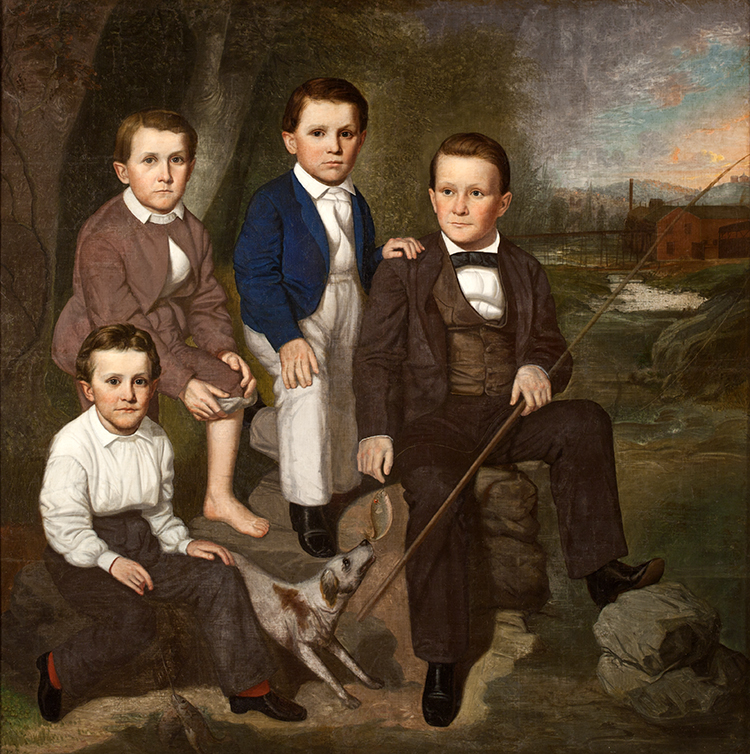
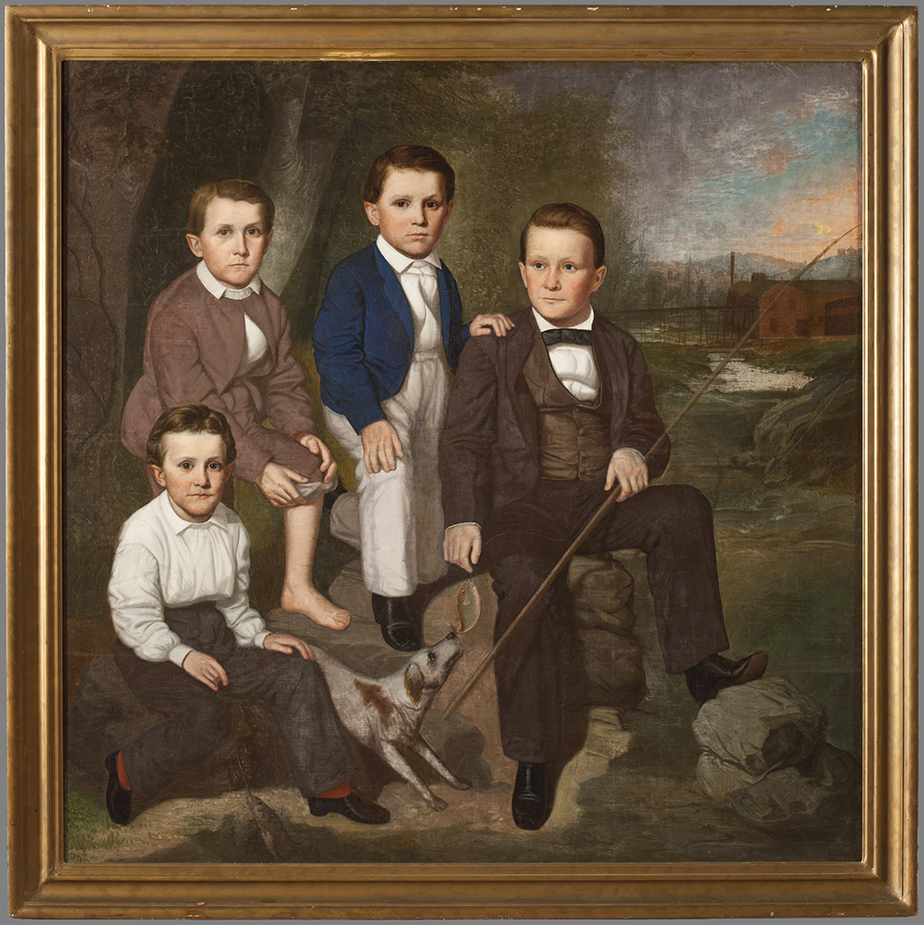
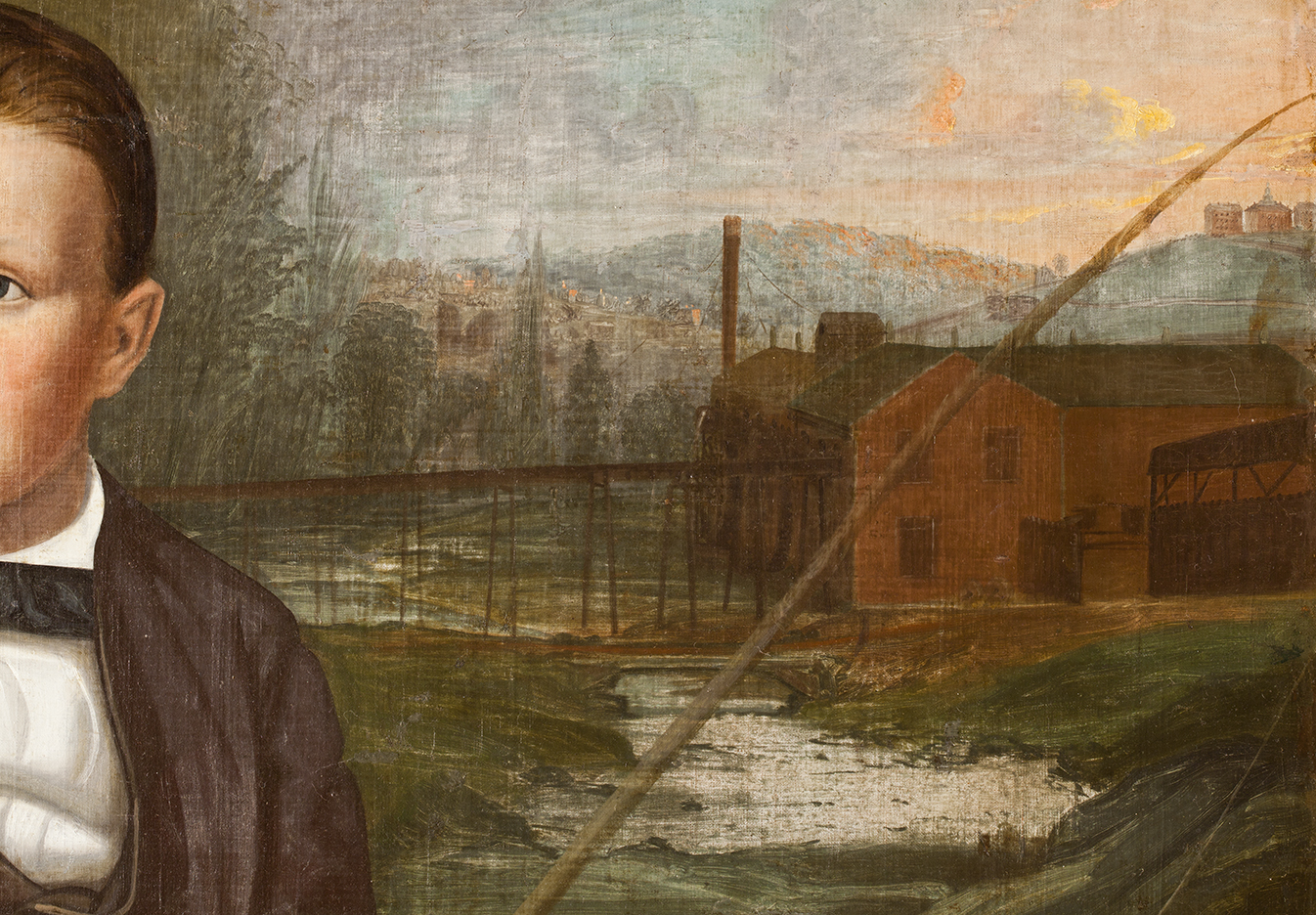
In 1862 the Powell family moved into “Lucknow”, an imposing Italianate home built by John J. Craig (1820-1892) of Florence, Alabama. The house, as well as the early buildings of Blount College, the future University of Tennessee, are visible just below the end of the fishing pole.
Shaver chose to place the young men on a bluff overlooking Second Creek, a gritty part of town dominated by the tanning industry. Tanning hides was a quintessential “backcountry” industry and represented the old economy of Knoxville. The new economy of knowledge and banking is represented by the University of Tennessee on the hill. Shaver strongly emphasizes the backwardness of the old economy and the bright future offered by the new economy through his use of color in the background of the image. This portrait suggests that the Powells are strong supporters of this new economy.
ARTIST: Portraitist Samuel M. Shaver (1816-1878) was born in Sullivan County in East Tennessee. He was the son of David Shaver (1776-1857) and Catherine (Barringer) Shaver. David and Catherine were married in Rowan County, North Carolina, in 1795. By 1801 the family owned land on Reedy Creek in Sullivan County, Tennessee, near the Virginia line.
Samuel Shaver may have been influenced by William Harrison Scarborough (1812-1871). Though Scarborough was born in West Tennessee, he painted in the Rogersville area between 1834-1835. During that period Scarborough painted portraits of some of Shaver’s relatives. Shaver’s earliest known painting dates to 1845.
In 1845 Shaver married Mary Hannah Elizabeth Powell (1825-1856), daughter of the late Congressman Samuel Powell. The Powells settled in Rogersville and had four children, one son and three daughters. In 1851 he was teaching in the Odd Fellows Female Institute and was listed in its catalog as “Professor Samuel M. Shaver; Drawing—Linear and Perspective; Painting of Miniatures and Painting in Water and Oil Colors.” Shaver also advertised n Greeneville and Knoxville newspapers. During this time he was regularly absent from Rogersville on commissions in East Tennessee and southwestern Virginia. A number of portraits from this period survive.
Hannah’s death in 1856 brought Shaver back to Rogersville. He would remain there until 1859 when he moved to Knoxville and established a studio on Gay Street. In Knoxville Shaver cemented his reputation as the portraitist of choice for East Tennessee’s elite.
In Knoxville Shaver was among the founders of the East Tennessee Art Association. During the Civil War The Association commissioned Shaver to paint portraits of fifteen Confederate political and military leaders. When Knoxville fell to Union forces in 1863 Shaver left for Russellville. After the Civil War he joined his mother-in-law and the rest of his family in Jerseyville, Illinois, near St. Louis, where he continued to paint portraits.
REFERENCES: James C. Kelly, “Samuel M. Shaver” in the Tennessee Encyclopedia (Tennessee Historical Society, 2018) https://tennesseeencyclopedia.net/entries/samuel-m-shaver/
April Strader Bullin, “The Powell Boys: Poignant and Political Messages of Samuel M. Shaver” in The Journal of Backcountry Studies, vol. 8, no. 1 (2013) http://libjournal.uncg.edu/jbc/article/view/730/416
DESCRIPTION: Painting has four young boys standing in a group on the bank of a river. The boy on the left is in a sitting position with a white collared shirt and dark gray pants, red socks and black shoes. He is holding a stringer of three fish that rest in the water. Second boy from the left is wearing a light brown suit with white collard shirt. He is standing barefoot with his pant leg rolled up, on a rock Third boy is wearing a white collared shirt and pants, with blue jacket and black shoes. He has his hand resting on the fourth boy’s shoulder, while he kneels on one knee. Fourth boy has dark brown suit with white collared shirt and black bow tie and shoes. He holds the fishing rod in one hand and rests it across his knee, and in his other hand he holds a freshly caught fish that a white and brown dog sniffs. In the background are trunks of trees that gradually change to greenery and then sky from left to right. In the distance on the right is a factory or mill with a bridge over a river.
In 1845 Shaver married Mary Hannah Elizabeth Powel, daughter of the late Congressman Samuel Powel. The couple lived with the congressman’s widow in Rogersville and were the parents of two daughters. In 1851 Shaver was professor of drawing and painting at the Odd Fellows Female Institute in Rogersville. In 1852 he advertised in Greeneville and Knoxville papers; for several years thereafter his whereabouts are unknown. The death of his first wife in January 1856 recalled him to Rogersville, where he remained until the Civil War.
At the outset of the war, pro-Confederate Shaver moved to Knoxville, where he became one of the founders of the East Tennessee Art Association. The association commissioned him to do portraits of fifteen Confederate leaders and generals, presumably from photographs. None of the portraits have been located, and perhaps they were never painted. From 1863 to 1868 Shaver lived and worked near Russellville. About 1868 he joined his mother-in-law and family in Jerseyville, Illinois, near St. Louis, where he continued painting. He died on June 21, 1878.
James C. Kelly, Virginia Historical Society
See Also: ART; HAWKINS COUNTY
Information provided by http://tennesseeencyclopedia.net/imagegallery.php?EntryID=S028