Bowl
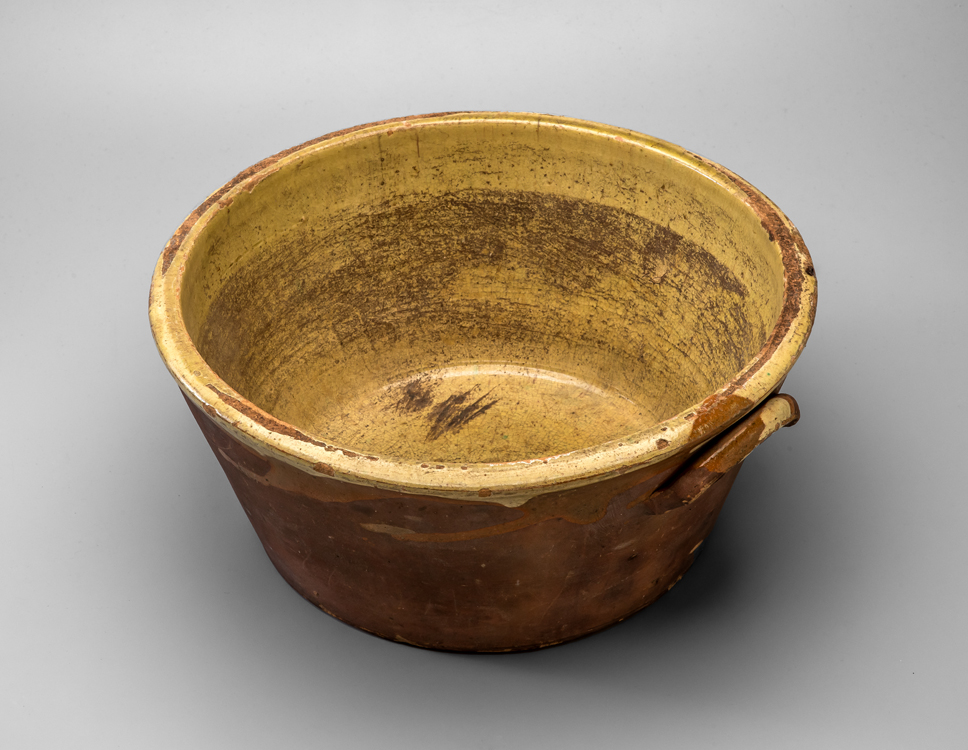
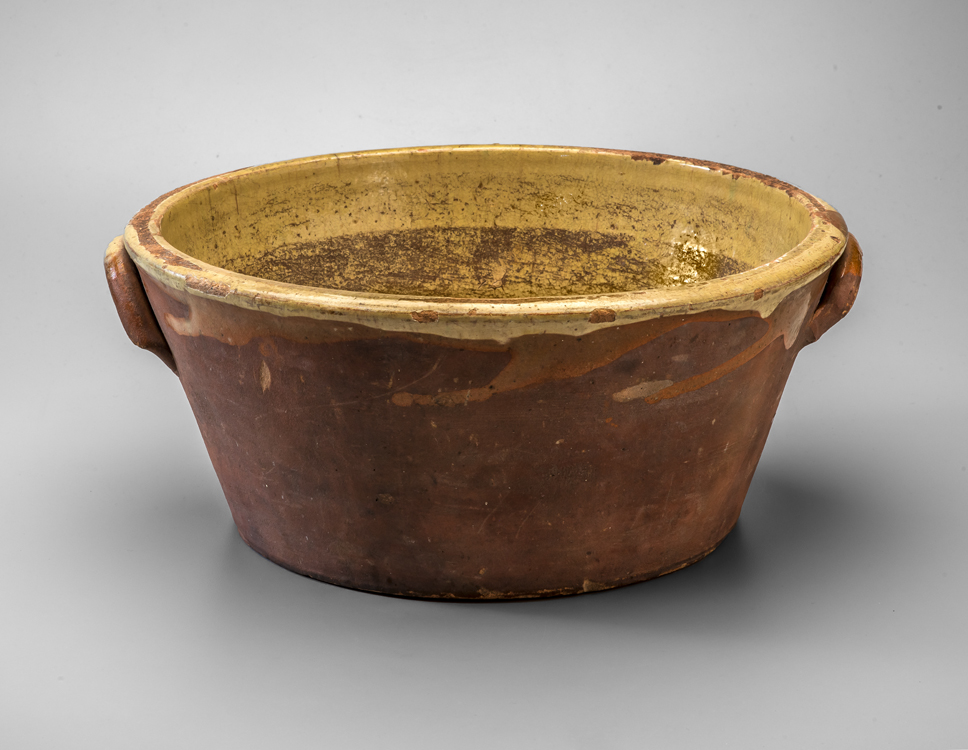
Thanks to family history, we know at least one way this bowl was used: Ida Henkel Painter (1878-1935) reportedly called this her “dough bowl.” With such a large diameter, this bowl was ideal for maximining the interaction of oxygen and leavening agents, while contianing the mass as it rose along its tall, steep sides.
Her “dough bowl” was discovered roughly a decade ago in the meat house of Indian Fort Stock Farm, the farm of Ida’s second husband Garnett Painter (1880-1960), near Hamburg, Shenandoah County, Virginia. Research by Jeffery Evans suggests a possible attribution to the shop of John Coffman, although exact comparable objects are not yet known. The Valley was a hotbead of ceramics production in the period, and the bowl may be the work of one of the many artisans whose name we know, but whose production remains unidentified.
If it is by Coffman’s New Market shop, it may lend weight to a line of descent through Ida’s familiy, the Henkels. Ida was the great-granddaughter of Dr. Solomon Henkel (1777-1847) and Rebecca Miller Henkel (1780-1854) of New Market through her father, Martin Mowrey Henkel (1857-1906).
The antecedents for the bowl, however, are far from the Shenandoah Valley. As Evans notes, “the overall form and slip-glazed interior…are typical of domestic vessels made in France during the 19th century, generally referred to as ‘tian’ bowls.” The resemblance is so strong that Evans initiated XRF analysis to compare local and French earthenware samples. Analyst Lindsay Block wrote that while “the elemental results cannot be deemed conclusive…the results do suggest that the piece has more in common with locally made pots from the Shenandoah Valley, as opposed to a European origin…Visually assessing the paste of the pan, I (Mrs. Bloh) found it to be inconsistent with French products I have examined.” It appears that the close parallels are a result of the French presence in the Valley itself rather than a case of an imported object.
Related objects in the MESDA Collection include an oyster jar discovered in the same loft of the outbuilding at Indian Stock Fort Farm (Acc. 6113), copperplate engravings of Solomon Henkel’s parents, the Reverend Paul Henkel and his wife Ellizabeth (Acc. 5550.4a&b), a fraktur for Siram Peter’s brother, Silon Amos Henkel (Acc. 5853), a profile portrait drawn by Silon Amos Henkel (Acc. 5163), a sideboard with a Henkel line of descent (Acc. 3350), and several examples of printed works by the Henkel Press.