
Alexander Calder

Artist/Maker
Morse, Samuel F. B.
Place Made
Charleston South Carolina United States of America
Date Made
1818-1820
Medium
oil on canvas
Dimensions
Framed: HOA: 36″; WOA: 29 3/4″
Canvas: HOA: 29 3/4″; WOA: 23 5/16″
Accession Number
5627
Description
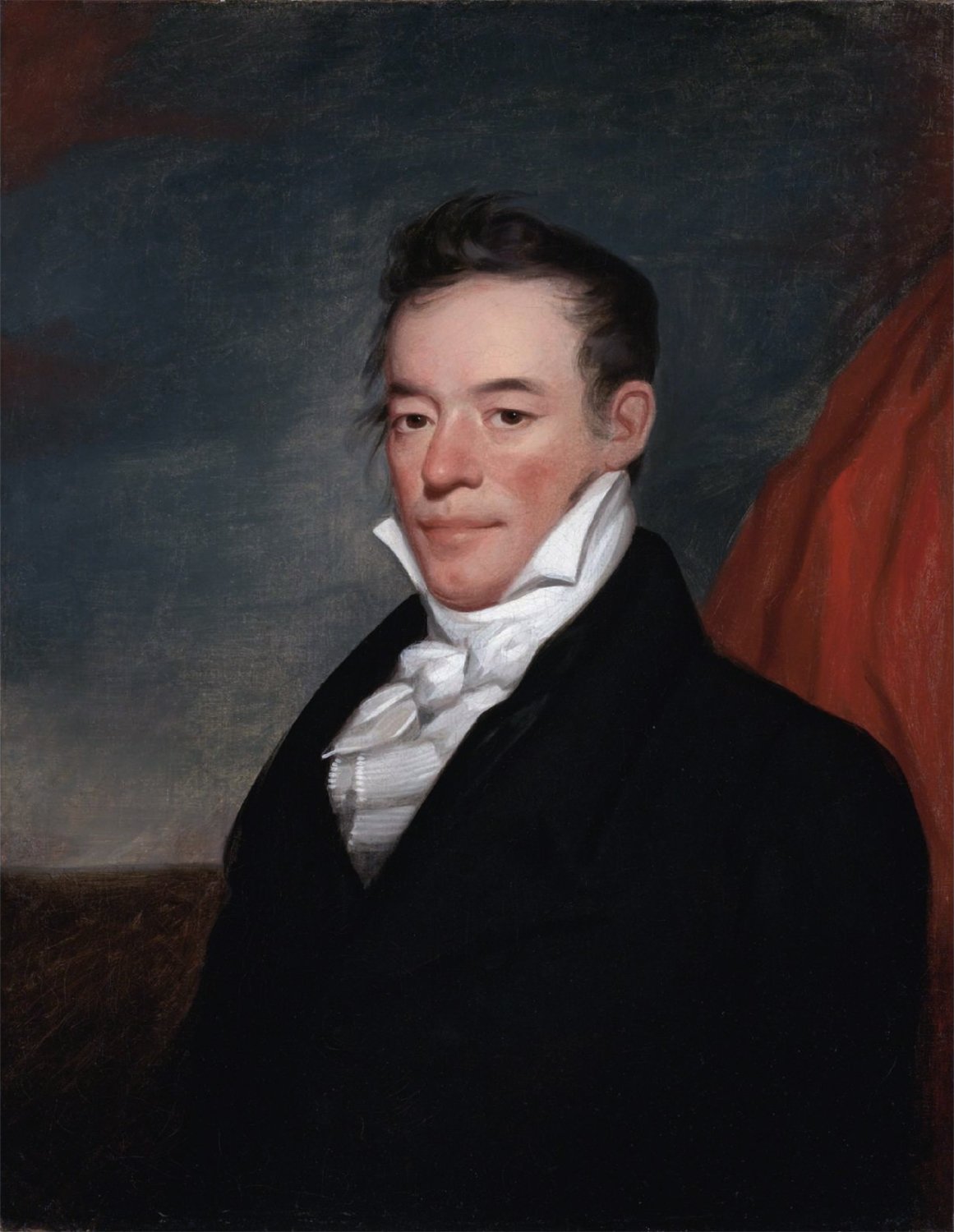
Oil on canvas portrait of a man wearing a dark coat with full white cravat and crisp collar. He has a ruddy complexion with rosy cheeks, nose and chin. His lips are not well defined but he has a dimpled chin, heavy-lidded brown eyes, and short dark hair. His hair flips upward in the front with slight wisps around the ears. He sits at a slight angle to the right. The background is accented with a red swatch of drapery behind the sitter on the proper left side. The right side features a deep horizon landscape of dark blue above and dark brown below the horizon. The sky with its dark blue is accented with hints of rose, especially in the upper right hand corner proper.

SITTER: Morse was introduced to Alexander Calder (1771-1849) the well established cabinetmaker and builder. Calder was born in Scotland and eventually moved to Charlestown by 1796. Not only was he famous for his fine cabinetry and furniture making, he was also a shipbuilder and business owner. Morse’s portrait speaks to Calder’s powerful name and status that he had spread throughout the South.

“In Morse’s fine portrait, Calder is a confident, upright, unaffected Scotsman. His ruddy-skinned, heavy-lidded face shines out atop a powerful torso clad in a dark green jacket and crisp white stock and collar. The rather arbitrary bold red swatch of drapery at the right makes an effective counterpoint to the dark jacket, while the aquamarine sky touched with rose lends a quiet note of approaching evening. ” (William Kloss, Samuel F. B. Morse, 1988, p.62)

The frame is gold leaf over plaster over wood. Having foliage and shell decoration with beveled detailing. There is cracking in the plaster and areas of loss throughout.

The painting was re-framed at some point. We are not sure if the painting was originally in this frame and just stabilized at a later point or it existed outside of this frame.
Artist Biography
ARTIST: Samuel Finley Breeze Morse was the son of Jedidiah Morse, the “father of American Geography.” He was born in Charlestown, Massachusetts. He attended Yale College where he was interested in experiments with electricity. Early in life he enjoyed drawing, and during his junior year, he started doing portaits for pocket money. By his senior year, he found satisfaction in painting because he was not the best student academically. During this time, Morse met Washington Allston and tried to persuade his parents to allow him to accompany Allston to England for study in the art. By 1811, his parents relented, and Morse sailed for London where he met and studied under Benjamin West. By 1815 he returned to America where he spent the next few years painting portaits in New England and Charleston, South Carolina. In 1818 he wintered in Charleston with his uncle, Dr. Finley Breeze. Morse was a success, supposedly doing fifty-three portaits during the winter. He returned to Charleston for several winters afterwards to do more portaits. In 1823, Morse settled in New York, and three years later he was a leader in the formation of the National Academy of Design of which he was the first president. From 1829 to 1833, Morse went to Europe. Morse devoted increasingly less time to his painting after he returned to New York during the 1840s when he became interested in experimentation with the daguerrotype and later in the telegraph. He died in New York. Morse is most famous for his invention of the telegraph and co-founder of the Morse code.
Credit Line
MESDA Purchase Fund